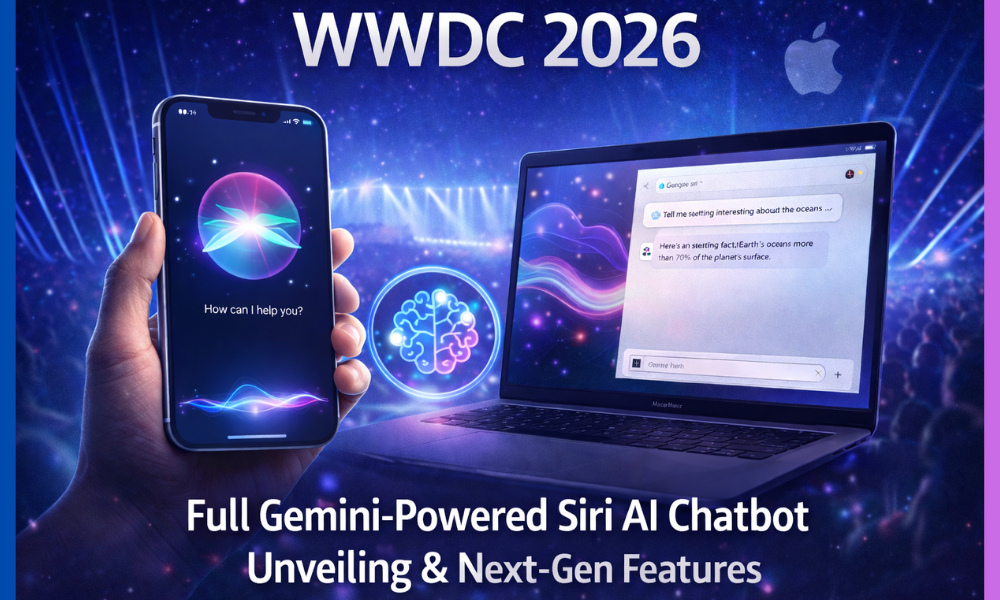
This two-stage rollout represents Apple’s strategy to integrate next-generation AI capabilities into Siri while maintaining its commitment to privacy, ecosystem integration, and user-friendly design. The February release will bring improved contextual understanding and task handling, while the WWDC update will introduce a full conversational AI experience, transforming Siri from a voice assistant into a sophisticated AI chatbot.
Gemini-Powered Siri: What to Expect in February 2026
According to reports, Apple plans to release an upgraded version of Siri in iOS 26.4, powered by Google’s Gemini AI models. This integration is expected to enhance Siri’s natural language processing capabilities, contextual understanding, and multi-step task execution, enabling the assistant to deliver smarter and more personalized responses.
Key Features of the February Update
Enhanced Context Awareness:
Siri will better understand ongoing conversations, on-screen content, and user context. This allows the assistant to provide more relevant answers and complete tasks more effectively.
Improved Task Handling:
Users will be able to issue complex, multi-step commands. For example, Siri could schedule meetings, adjust reminders, and pull up related information in one seamless interaction.
Smarter Natural Language Understanding:
Gemini’s AI models will allow Siri to comprehend nuanced queries and respond more accurately, reducing misunderstandings and improving overall user satisfaction.
Ecosystem Integration:
Siri will continue to work across iPhone, iPad, Mac, and HomePod devices, leveraging Apple’s Private Cloud Compute infrastructure to balance AI processing power with data privacy.
Although this update won’t fully transform Siri into a chatbot, it will feel more capable, responsive, and intelligent, setting the stage for the more ambitious AI features expected at WWDC.
The Role of Google Gemini in Siri’s Evolution
Apple’s decision to power Siri with Google’s Gemini models is notable because it represents a collaboration between two major competitors in the tech industry. Apple reportedly determined that Gemini’s advanced AI capabilities would accelerate Siri’s evolution more effectively than building a purely in-house model.
While Apple will market the update as part of its Apple Intelligence initiative, Gemini’s influence is central to the backend AI engine. This partnership allows Siri to:
Process complex queries with advanced reasoning
Generate more human-like responses
Handle multi-turn conversations more effectively
By integrating Gemini AI, Apple can also focus on its privacy-centric approach, ensuring that sensitive data remains protected while benefiting from cutting-edge generative AI technology.
WWDC 2026: Full AI Chatbot Upgrade
The major transformation of Siri is expected at WWDC 2026 in June, where Apple will unveil a fully reimagined conversational AI assistant. This version is rumored to be built on Apple Foundation Models version 11 and will allow Siri to function as a true AI chatbot, capable of sustained dialogue, contextual reasoning, and advanced task execution.
Expected Capabilities
Conversational Continuity:
Users can have back-and-forth conversations with Siri without losing context, making interactions feel more natural and intelligent.
Advanced Contextual Understanding:
Siri will integrate information across devices, apps, and user history to provide accurate and actionable responses.
Generative AI Abilities:
The chatbot may generate content, provide creative suggestions, or summarize information — similar to ChatGPT and other leading AI assistants.
Cloud-Powered Performance:
Leveraging Gemini and Apple’s cloud infrastructure, Siri will be able to handle complex queries and large-scale AI computations while maintaining user privacy.
This WWDC upgrade is expected to position Siri as a serious contender in the AI assistant space, bridging the gap with Google Assistant, OpenAI’s ChatGPT, and emerging AI chatbots.