Google’s Gemini chatbot is moving past model AI responses and towards providing personalized AI with its latest capability to pull data from Gmail and Photos for its users who allow this. This feature should produce more customized answers and increase the usefulness of Gemini. However, Google has acknowledged that Gemini may not be able to assist in sensitive areas, such as providing advice on relationships. This illustrates how the capabilities of personal AI continue expanding, while also indicating some of the boundaries.
What Does Google Gemini’s Personalised Intelligence Feature Mean to You?
Google has launched another feature for its new Gemini app that enhances its capability to understand your context. With this latest upgrade, Gemini will be able to provide you with personalised responses using information stored in all of your Google apps for instance, your email (Gmail) and photos (Google Photos). The ultimate objective of Personalised Intelligence is to transform the way the intelligent assistant (Gemini) works for you, as opposed to giving you generic answers, Gemini will have access to your personal context and be able to give you faster and more accurate responses.
Google is advertising this feature as being a personal assistant that stores the important information that you provide, unlike conventional chatbots that are just computers providing you with the answers to your questions based on their programming. However, you can choose whether or not to allow Google to access your personal information, it is completely up to you. Google has also stated that because this new feature provides convenience to users, it has limitations when dealing with emotionally complex situations; therefore, it is a step toward an artificial intelligence system that provides more human-like responses but is still based on patterns and data, not on real empathy.
How Gemini Uses Gmail, Photos, and Search to Answer Questions
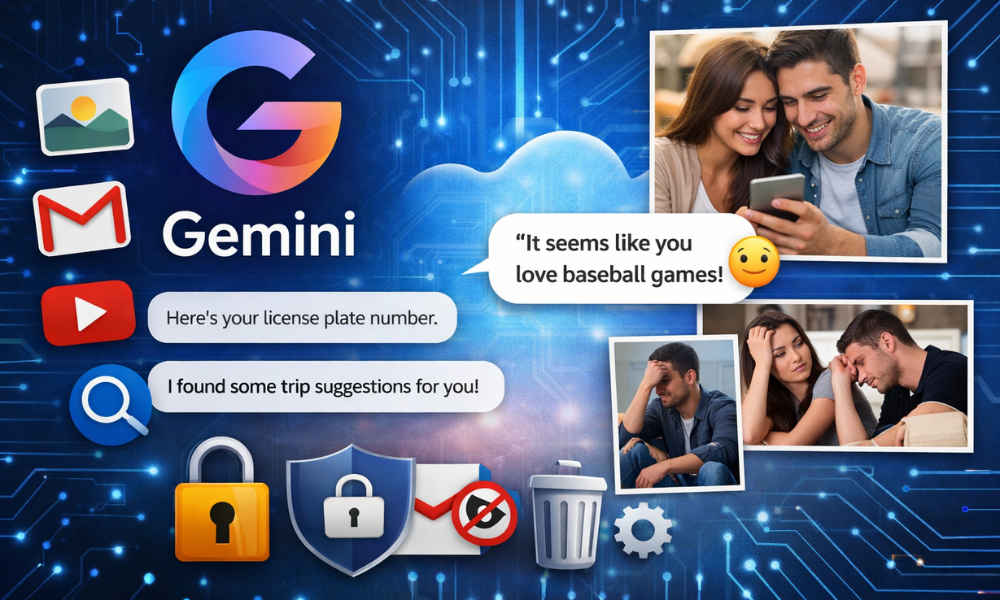
Gemini employs Gmail, Photos, and Search in concert to obtain answers to questions by using its Personalised Intelligence functionality. Gemini uses Google’s services to access and collect data associated with its owner and then employs this data to answer questions directly from the user. For instance, if a person asked Gemini for their vehicle’s licence plate number or tyre size, Gemini could look through relevant pictures of the vehicle or previous email correspondence from the user to find that information. The benefit of this feature is that it allows for an easier and faster way to locate information about your vehicle than having to physically search through multiple applications to find the same data that would otherwise be available on an individual app. Google provides other examples of how Gemini is used to help users with family functions, as they have shown that Gemini can analyse data from the past (including travelling history) and present suggestions for family trips or itineraries based on the data analysed. Gemini could even offer other suggestions, such as recommending overnight train experiences or suggesting board games based on previous engagement with those products. Because it connects different data sources into one integrated experience, Gemini provides convenience and time savings for users when planning or making decisions.
Where Gemini Struggles – Relationships and Understanding Context
Though it has strong capabilities for data processing, Google confesses that Gemini has some difficulties when dealing with complex personal issues, particularly when it comes to relationships. This is due to the patterns that the AI system recognizes in the data from the user. The system may end up with inappropriate guesses. For example, the system guesses that the user likes baseball just because a large number of photos have been taken from the baseball stadium. However, the system does not have the capability to understand the emotional and situational contexts associated with visiting the baseball stadium. This problem may occur when the individual goes through separation or a divorce. In such cases, the photos in Google Photos continue to influence the system incorrectly. This problem demonstrates that the system does not have emotional intelligence. This situation can be corrected when the individual directly informs the system through corrective feedback.
User Control Needed for Personal Intelligence in Privacy Policy and for Transparency
As Gemini accesses different personal data, there is a concern about the privacy of this information and how to protect it. According to Google, Gemini’s access to a user’s personal data includes privacy protections such as not using images or user data for training purposes. Google says that Gemini only keeps the temporary metadata of the data used to train Gemini to answer specific questions. The training of Gemini was based on various types of prompt/answer combinations where they filtered or modified identifying information for privacy purposes. Therefore, if Gemini identifies a vehicle’s license plate in an image, it does not retain that actual license plate number in its records. To offer users the highest level of transparency possible, Gemini lets users know which application was used to generate that personalized response. Gemini allows users to ask follow-up questions for clarification and to take corrective action on their answer if that is warranted. Users also maintain exclusive control over the apps connected to Gemini by having the ability to select which applications will be connected as well as the option to change access or remove chat history at any time. This will ensure that users retain complete control over the application and their data, thereby providing them with the flexibility to do so.
Conclusion
Google Gemini’s personalized intelligence represents a huge move towards more contextually aware AI-based assistance. By introducing the capability to access apps like Gmail and Photos, Google Gemini can provide faster and more relevant responses to queries and make simpler tasks easier to complete. Yet, the key weakness mentioned by Google itself underlines the fact that emotional intelligence and complex personal scenarios, particularly relationships, continue to pose huge challenges to AI-based intelligence. Although privacy options bring more confidence to users, it is again confirmed that human intelligence is imperative to the system. Intelligence and personalization of Google Gemini may reach new levels, but it is not ready to understand personal emotions or changes occurring in one’s personal life, thereby requiring inputs and corrections by the user to its assistance.