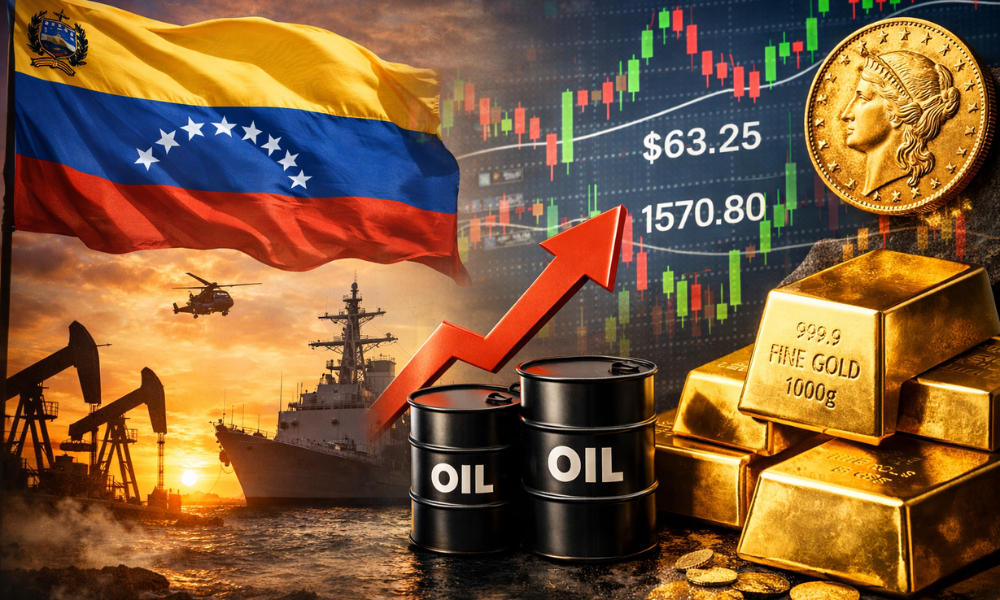
Global financial markets have returned to the spotlight as the US has recently escalated its tensions with Venezuela, a country that does not represent a predominant share of the world’s oil supply but nonetheless contributes an important portion of global crude oil exports. The recent disruptions to the Venezuelan oil export capacity and fears of what will happen next from these geopolitical issues have increased volatility in energy markets and raised demand for most traditional safe-haven assets. In the face of growing uncertainty, gold—particularly heavy crude oil—as well as other commodities, are now seen as the major commodities for which investors must remain focused.
The Geopolitical Trigger Shocking World Markets
The escalating conflict between Venezuela and the United States has again ignited worries about geopolitics in global markets. The conflict escalated on January 3, 2026, when US forces arrested Venezuelan President Nicolás Maduro, establishing a naval blockade that has directly affected Venezuelan crude exports from the country. Although there are, as yet, few implications from a macro perspective for global supply chain networks, it is the potential for further unforeseen developments that has sparked a marked reaction in markets today, as opposed to worrying about potential losses inherent within current positions. The Venezuelan economy has a heavy reliance on crude exports, meaning that any level of interference related to these exports has a significant implication for investment within a globe characterized by investment instability due to unforeseen developments that can, at times, independently influence key investment dynamics, including inflationary expectations, monetary policy, and, as in this current case, crude import levels related to Venezuela’s naval exports.
Why Oil Quality Matters More Than Oil Quantity
Although Venezuela contributes no more than 1% of world-wide oil production, with a production level of some 800,000 to 1.1 million barrels a day, the reaction in the oil market has been proportionally unprecedented. The relevant point is not the volume of Venezuelan oil production, according to Aamir Makda of the brokerage firm Macquarie Analytics in Singapore. The relevant point is the type of oil Venezuela produces. Venezuela “is a major ‘heavy -sour’ crude supplier. Heavy-Sour crude is a type of crude ‘designed for processing in the US Gulf Coast refineries.” Additionally, Venezuelan heavy crude cannot be easily replaced with lighter varieties. The US Navy has effectively blocked the docking of the necessary number of tankers at the Venezuelan port of Maracaibo.”
Which Oil Benchmarks Are Under Pressure
Although global crude benchmarks like Brent and WTI are also showing the impact of the rising geopolitical tensions, the pinch is more clearly visible in regional crude benchmarks for heavy crude. Makda states that Mars heavy crude in the Gulf Coast region of the US has been identified as the most affected crude market due to the ripple effect. Mexican Maya and Western Canadian Select are also under pressure due to refiners looking for alternative crude sources to Venezuelan heavy sour crude due to the political instability in the country. This impact is palpable in the market with the differential between light crude oil like Brent and heavy crude collapsing considerably. Heavy crude oil prices are rising more due to the increase in demand, which indicates regional shortages rather than a global problem of availability. Brent crude oil, trading in the range of $61-65 per barrel in early January, already carries a $3-5 geopolitical premium even though the global market has maintained its balance with adequate inventories to meet the demand.
The Role of Geopolitical Tension in Gold Price Increases
The increase of gold prices due to geopolitics has come primarily from the United States and Venezuela. In the short term, Makda has interpreted this as the catalyst that has increased demand for gold as a safe haven, and has been helpful in bringing attention to the gold market. However, he believes it is too soon to declare Venezuela a major cause of the strong increase in gold prices. Rather, the primary drivers for the current strength of gold continue to be the macroeconomic factors. While low-interest rates, from the Federal Reserve’s monetary policy, are an important factor, the primary driver of gold prices remains the historical decline of the US dollar over the past several years. When interest rates are low, there is less opportunity cost to holding gold versus a bond or stock investment because you will receive no interest. Therefore, the geopolitical turmoil resulting from US-Venezuela relations acts to reinforce the trend of increasing gold prices which is currently due to macroeconomic conditions. Hence, while Venezuela has further enhanced the trend of increasing gold prices, the more significant contributors remain the macroeconomic drivers of gold, such as the decline of the US dollar and low interest rates.
Conclusion
The tension between the US and Venezuela has brought about a new element of uncertainty to markets overall for oil and gold. Although the overall disruption to oil supplies does not have an immediate shock oscillation associated with it, the particular focus on ‘heavy-sour’ crude and bottlenecks in the logistics chain brought about an immediate shock oscillation in price. Gold markets, however, experienced an immediate positive shock oscillation due to its inherent safe-haven properties with an additive factor of easy money and the consequent fall of the value of the dollar. Theoretically significant for an investor is the understanding that commodity prices respond swiftly to geopolitical shock oscillations and that the forces of supply and demand ultimately govern markets.