In today’s fast-changing digital economy, businesses are under constant pressure to improve efficiency, reduce operational costs, and make faster, data-driven decisions. From small startups to large enterprises, managing finance, inventory, human resources, customer relationships, and production processes through separate systems often leads to data silos, duplication of work, and operational inefficiencies. This is where Enterprise Resource Planning (ERP) software plays a transformative role. Among the global players in this space, Zoho has emerged as a strong innovator, introducing a new integrated ERP platform designed to simplify business operations and support sustainable growth.
Modern businesses operate in a highly competitive environment where speed, accuracy, and adaptability determine success. Traditionally, many organizations relied on multiple standalone software tools—one for accounting, another for inventory, a separate system for HR, and yet another for customer management. While these tools served individual purposes, they often failed to communicate seamlessly with one another. As a result, businesses faced challenges such as inconsistent data, delayed reporting, and increased dependency on manual processes.
An integrated ERP system addresses these challenges by bringing all core business functions under one unified platform. It allows real-time data sharing across departments, improves transparency, and enables management to gain a holistic view of the organization. Zoho’s new ERP offering is built around this very philosophy—creating a single, connected ecosystem that supports every stage of business operations.
Zoho has long been known for its wide range of cloud-based business applications, serving millions of users worldwide. With its new ERP platform, Zoho aims to redefine how businesses manage their end-to-end operations. Instead of forcing companies to adapt to rigid software structures, Zoho’s ERP is designed to be flexible, scalable, and customizable according to specific industry needs.
The platform integrates finance, sales, purchasing, inventory, manufacturing, human resources, and analytics into one cohesive system. This unified approach ensures that data entered in one module automatically reflects across others, eliminating redundancy and minimizing errors. For example, a sales order can directly update inventory levels, trigger procurement actions, and reflect in financial accounts without manual intervention.
One of the most significant strengths of Zoho’s ERP is its modular yet integrated design. Businesses can start with essential modules and gradually expand as their operations grow. This makes it particularly attractive for small and medium-sized enterprises that need robust functionality without the complexity and cost of traditional enterprise systems.
Another important feature is automation. Zoho’s ERP leverages workflow automation to handle repetitive tasks such as invoice generation, purchase approvals, inventory reordering, and payroll processing. Automation not only saves time but also reduces the risk of human error, allowing employees to focus on strategic and value-added activities.
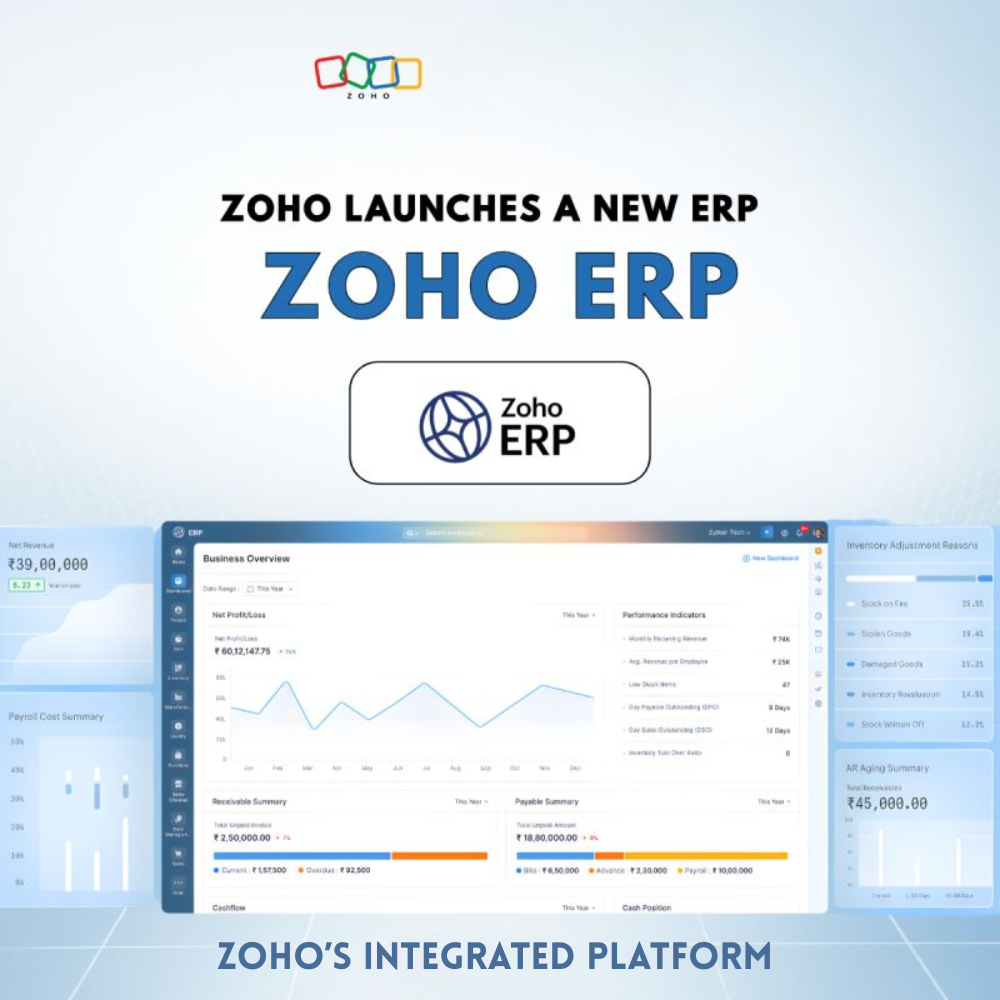
The platform also offers advanced reporting and analytics. Real-time dashboards provide insights into key performance indicators across departments. Decision-makers can track cash flow, monitor sales performance, analyze production efficiency, and identify bottlenecks with ease. This data-driven approach empowers businesses to make informed decisions quickly and confidently.
Zoho’s ERP is built on a cloud-first architecture, making it accessible from anywhere and on any device. This is especially important in today’s hybrid and remote working environment. Cloud deployment reduces the need for heavy IT infrastructure, lowers maintenance costs, and ensures regular updates without disruption.
Security and data privacy are also central to Zoho’s ERP strategy. The platform follows global security standards, offers role-based access control, and ensures that sensitive business data remains protected. As businesses scale, the ERP system can easily accommodate increased data volumes, users, and operational complexity without compromising performance.
One of the challenges businesses often face with ERP implementation is the lack of industry relevance. Generic systems may not fully address the unique requirements of sectors such as manufacturing, retail, services, or distribution. Zoho addresses this gap by offering industry-specific configurations and customization options.
For manufacturing businesses, the ERP supports production planning, bill of materials, quality control, and shop-floor management. Retail and trading companies benefit from features like inventory optimization, multi-warehouse management, and order tracking. Service-based organizations can manage projects, billing, and customer engagement seamlessly within the same system.
Zoho’s ERP platform holds particular significance for Indian businesses, many of which are undergoing rapid digital transformation. Small and mid-sized enterprises in India often seek affordable yet powerful solutions that can support growth without excessive complexity. Zoho’s pricing model, local support, and understanding of regional business practices make it a strong fit for this segment.
At the same time, Zoho’s global presence ensures that the ERP platform meets international standards and can support businesses operating across borders. Multi-currency support, compliance features, and localization options make it suitable for companies with global ambitions.
As technology continues to evolve, ERP systems are no longer just back-end tools; they are becoming strategic enablers of innovation and growth. Zoho’s new ERP platform reflects this shift by combining integration, automation, analytics, and flexibility into a single solution.
Looking ahead, the integration of artificial intelligence and machine learning is expected to further enhance ERP capabilities. Predictive analytics, intelligent recommendations, and smarter automation will help businesses anticipate challenges and seize opportunities proactively. Zoho’s strong focus on continuous innovation positions it well to lead this next phase of ERP evolution.

Zoho’s new integrated ERP platform marks a significant step forward in simplifying and streamlining business operations. By unifying core functions, automating processes, and providing real-time insights, it empowers organizations to operate more efficiently and competitively. For businesses seeking a modern, scalable, and user-friendly ERP solution, Zoho’s offering represents a new era—one where technology works seamlessly in the background, allowing businesses to focus on growth, innovation, and long-term success.
Hemangi specializes in writing business articles that inform, engage, and inspire action.