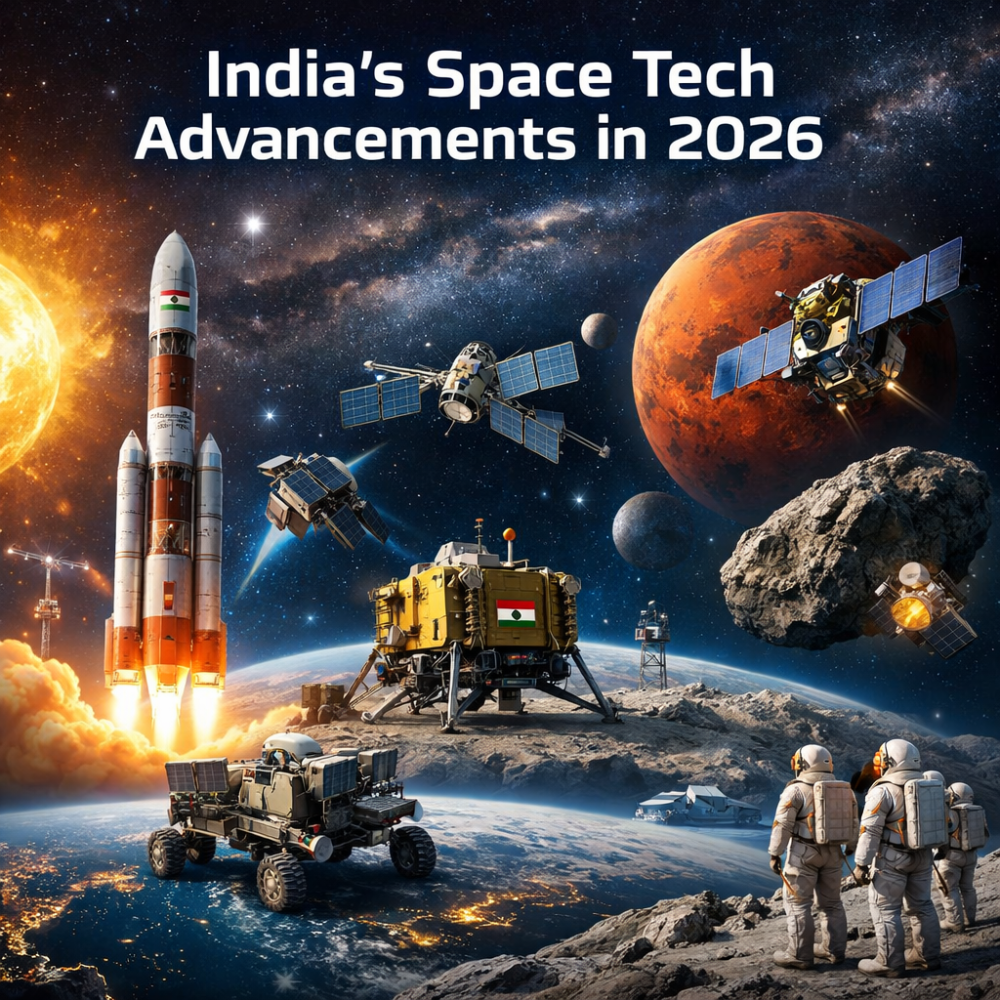
India’s space sector is entering a defining phase in 2026, marked by rapid technological advancements, ambitious missions, and growing global recognition. From next-generation satellites that support everyday life on Earth to deep space missions that expand humanity’s understanding of the universe, India’s space technology ecosystem is evolving faster than ever. Spearheaded by the Indian Space Research Organisation (ISRO) and strengthened by private players under the NewSpace India initiative, the country is positioning itself as a major force in the global space economy.
A New Era for India’s Space Program
India’s space journey has always been driven by innovation, cost-efficiency, and national development goals. What makes 2026 special is the convergence of advanced launch capabilities, deep space exploration, human spaceflight preparation, and commercial participation. The focus has shifted from proving capability to scaling impact—both scientifically and economically.
ISRO’s roadmap for 2026 reflects this maturity, combining scientific exploration with practical applications such as communication, navigation, disaster management, climate monitoring, and national security.
Advancements in Satellite Technology
Satellites remain the backbone of India’s space program, and 2026 will see a new generation of spacecraft with enhanced capabilities. These satellites are designed to be lighter, smarter, and more durable, using advanced materials and AI-enabled systems.
Key areas of satellite advancement include:
Earth Observation Satellites: Improved resolution and real-time data processing for agriculture, urban planning, disaster response, and environmental monitoring.
Communication Satellites: High-throughput satellites to support digital connectivity, broadband expansion, and rural communication.
Navigation Systems: Upgrades to India’s regional navigation system to improve accuracy for civilian and strategic use.
These satellite missions directly impact governance, infrastructure planning, weather forecasting, and economic development, making space technology an integral part of everyday life.
Launch Vehicle Innovations
India’s launch vehicle capabilities are also evolving rapidly. In 2026, ISRO continues to strengthen its reliable launch systems while introducing next-generation and reusable technologies.
Key developments include:
Enhanced versions of PSLV and Gaganyaan-compatible launch systems for diverse payload requirements.
Progress in reusable launch vehicle (RLV) technologies aimed at reducing mission costs and increasing launch frequency.
Greater focus on small satellite launch services, aligning with global demand for cost-effective access to space.
These innovations not only support domestic missions but also strengthen India’s position as a preferred launch partner for international customers.
Deep Space Missions: Expanding Scientific Horizons
One of the most exciting aspects of India’s space advancements in 2026 is its growing emphasis on deep space exploration. Building on the success of earlier lunar and planetary missions, ISRO is expanding its scientific ambitions beyond Earth orbit.
Deep space missions focus on:
Advanced lunar exploration to study surface composition and long-term habitability prospects.
Solar and space weather missions to better understand the Sun’s behavior and its impact on Earth.
Planetary science missions that explore the origins and evolution of the solar system.
These missions are not only scientific milestones but also technological testbeds for propulsion systems, long-duration communication, and autonomous spacecraft operations.
Human Spaceflight and Gaganyaan Progress
Human spaceflight remains a cornerstone of India’s long-term space vision. In 2026, significant progress continues under the Gaganyaan program, which aims to send Indian astronauts into low Earth orbit.
Key areas of advancement include:
Crew module safety systems and life-support technologies
Human-rated launch vehicle testing
Astronaut training and mission simulations
These efforts reflect India’s growing confidence in handling complex, human-centric space missions and lay the groundwork for future crewed exploration.
Rise of Private Space Startups
A defining feature of India’s space ecosystem in 2026 is the rise of private space startups. Enabled by policy reforms and institutional support, private companies are contributing to satellite manufacturing, launch services, propulsion systems, and space applications.
Private sector involvement brings:
Faster innovation cycles
Cost optimization through competition
New business models in satellite data, space analytics, and in-orbit services
This public–private collaboration is transforming India from a government-led space program into a dynamic space economy.
Space Applications Driving National Development
India’s space advancements are not limited to exploration—they play a critical role in national development. Satellite-based services in 2026 are supporting:
Precision agriculture and food security
Disaster early warning systems for cyclones, floods, and earthquakes
Climate change monitoring and environmental protection
Smart city planning and infrastructure development
By integrating space technology into governance, India is leveraging its space assets for inclusive growth and sustainability.
International Collaboration and Global Standing
India’s growing technological capability has strengthened its position as a trusted global space partner. In 2026, international collaborations continue in areas such as satellite launches, joint scientific missions, data sharing, and technology exchange.
India’s reputation for reliable, cost-effective, and innovative space solutions makes it an attractive partner for both developed and emerging space nations.
Focus on Sustainability and Space Debris Management
As space activity increases, sustainability has become a critical concern. India’s space program in 2026 emphasizes responsible practices, including:
Space debris monitoring and mitigation
End-of-life disposal strategies for satellites
Environmentally conscious launch practices
This commitment reflects India’s role as a responsible spacefaring nation focused on long-term orbital sustainability.
The Road Ahead for India’s Space Tech
India’s space advancements in 2026 represent a strategic shift from capability demonstration to global leadership and economic impact. With strong foundations in satellite technology, launch systems, deep space exploration, and human spaceflight, the country is well-positioned for the next phase of growth.
Future priorities include deeper planetary exploration, commercial space expansion, space-based manufacturing research, and long-duration human missions.

India’s Space Tech Advancements in 2026: From Satellites to Deep Space Missions reflect a nation confident in its scientific vision and technological capability. As satellites become smarter, missions reach farther into space, and private players join the ecosystem, India’s space program is transforming into a powerful engine of innovation, national development, and global collaboration.
In 2026, India is not just reaching for the stars—it is building a sustainable, inclusive, and future-ready space ecosystem that will define its role in the global space community for decades to come.
Kinjal is a professional content creator with a passion for turning thoughts and ideas into engaging, impactful words. She enjoys exploring a wide range of topics and brings creativity, clarity, and enthusiasm to everything she writes.