Understanding 3-Year Returns in Equity Mutual Funds
Three-year returns are a commonly used performance metric because they balance short-term market cycles with medium-term consistency. While they do not guarantee future performance, they help investors assess how a fund has navigated different market conditions.
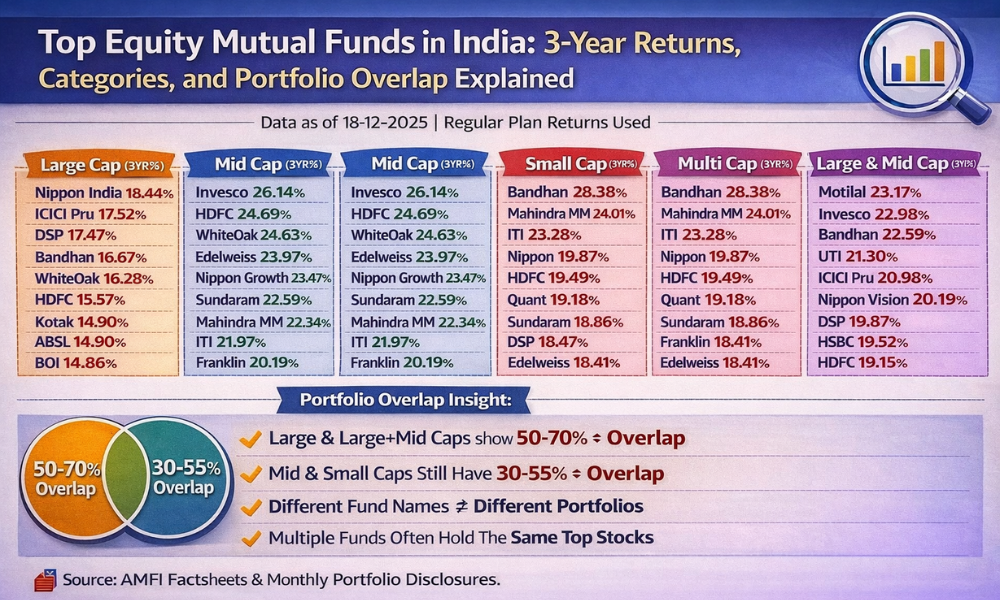
The data shown is based on regular plan returns and the latest portfolio disclosures, making it useful for comparative analysis across fund houses and categories.
Large Cap Mutual Funds: Stability with Moderate Growth
Large cap funds invest primarily in well-established companies with large market capitalization. These companies are generally stable, market leaders, and less volatile than mid or small caps.
According to the data:
- Nippon India leads large cap funds with around 18.44% 3-year returns.
- ICICI Prudential and DSP follow closely with returns in the range of 17–18%.
- Other consistent performers include Bandhan, WhiteOak, HDFC, Kotak, and Baroda BNP.
Large cap funds are suitable for conservative to moderate investors who prioritize stability, predictable returns, and lower volatility compared to other equity categories.
Mid Cap Mutual Funds: Balanced Risk and Higher Growth Potential
Mid cap funds invest in companies that are in their growth phase—bigger than startups but not yet industry giants. This category often delivers higher returns but comes with higher risk.
Top performers in the mid cap category include:
- Invesco with an impressive 26.14% 3-year return.
- HDFC, WhiteOak, Edelweiss, and Nippon Growth all delivering returns above 23%.
- Funds like Sundaram, Mahindra Manulife, ITI, Tata, and Franklin also show strong consistency.
Mid cap funds are ideal for investors with a medium to high risk appetite and a long-term investment horizon.
Small Cap Mutual Funds: High Risk, High Reward
Small cap funds invest in emerging and relatively smaller companies with high growth potential. While returns can be extraordinary during bullish phases, these funds are also the most volatile.
The data highlights:
- Bandhan Small Cap leading with around 28.38% returns.
- Mahindra Manulife, ITI, Nippon, HDFC, and Quant showing strong performance between 19–24%.
- Other notable names include Sundaram, DSP, Franklin, and Edelweiss.
Small cap funds are best suited for aggressive investors who can tolerate short-term volatility and stay invested for the long run.
Multi Cap Funds: Diversification Across Market Sizes
Multi cap funds invest across large, mid, and small cap stocks, offering built-in diversification.
Top performers include:
- Kotak with around 22.19% returns.
- Axis, Nippon, LIC, and HDFC delivering returns close to 20%.
- Other funds like Mahindra Manulife, ICICI Prudential, ITI, and Baroda BNP provide stable outcomes.
Multi cap funds suit investors who want exposure to all market segments without actively rebalancing their portfolio.
Flexi Cap Funds: Freedom to Adapt
Flexi cap funds allow fund managers to invest freely across market capitalizations based on opportunities.
Leading flexi cap performers:
- Parag Parikh Flexi Cap at around 21.16%.
- Motilal Oswal, HDFC, Invesco, and Bank of India close behind.
- WhiteOak, ITI, Baroda BNP, and Sundaram also feature strongly.
Flexi cap funds are suitable for investors who trust active fund management and want flexibility during changing market cycles.
Large & Mid Cap Funds: A Blend of Stability and Growth
Large & mid cap funds allocate investments between large and mid-sized companies, aiming for a balance between risk and returns.
Top funds include:
- Motilal Oswal with about 23.17% returns.
- Invesco and Bandhan with returns above 22%.
- UTI, ICICI Prudential, Nippon Vision, DSP, HSBC, HDFC, and Axis follow closely.
This category works well for investors seeking higher growth than large caps but with less volatility than pure mid-caps.
Portfolio Overlap: The Hidden Reality of Mutual Fund Investing
One of the most important insights from the image is portfolio overlap—a factor many investors ignore.
Key Overlap Insights:
- Large Cap and Large & Mid Cap funds show 50–70% overlap.
- Mid Cap and Small Cap funds still have 30–55% overlap.
- Different fund names do not always mean different portfolios.
- Many funds hold the same top stocks, especially market leaders.
This means owning multiple funds from different houses does not always ensure true diversification.
Why Portfolio Overlap Matters
High portfolio overlap can:
- Reduce the benefits of diversification
- Increase concentration risk unknowingly
- Make portfolios more vulnerable during market corrections
For example, owning three large cap funds may feel diversified, but if all hold similar stocks, actual exposure remains concentrated.
Smart Investment Takeaways
- Returns alone should not guide fund selection
Consistency, risk management, and portfolio composition matter.
- Avoid unnecessary fund duplication
Too many funds with similar holdings add complexity without benefit.
- Diversify across categories, not just fund houses
Mix large, mid, small, and flexi cap funds wisely.
- Review portfolios periodically
Overlap changes as fund managers rebalance holdings.
- Align funds with your risk profile and goals
Aggressive returns are meaningless if they cause panic during volatility.