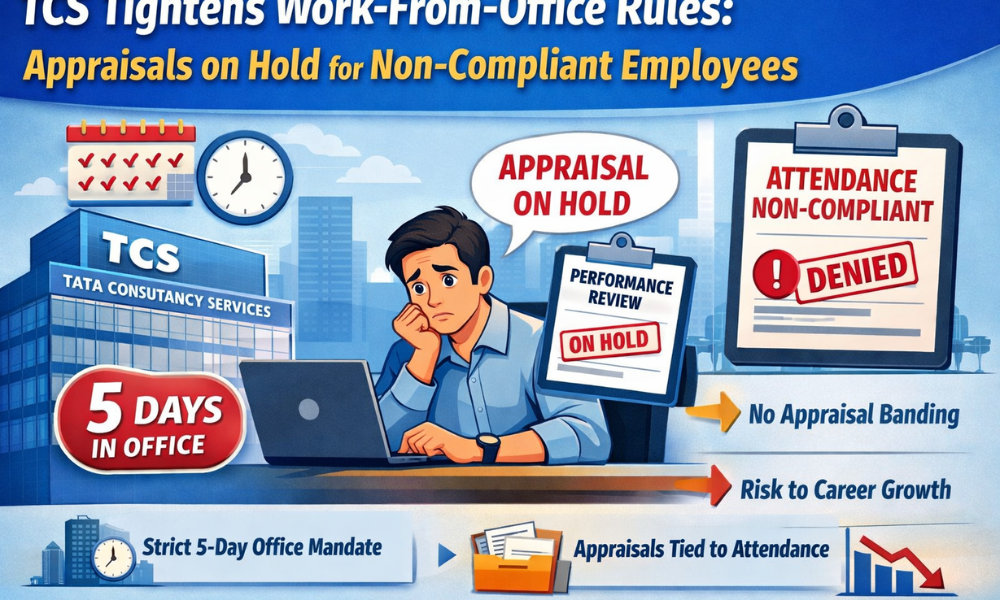
Tata Consultancy Services (TCS) is clear about its strategy for returning to the office: All employees must be in the office five days a week. In a bold new direction, TCS has suspended end-of-year performance appraisals for employees who did not meet the company’s requirement of having been in the office for all four quarters. This is a clear indication that TCS associates physical presence in the office with performance, and that TCS will enforce this requirement more rigorously throughout the company. As the industry continues to have this discussion regarding hybrid working arrangements, this decision from TCS will likely have a direct impact on how employees feel about their jobs, how their appraisals will be affected, and the potential for career advancement.
Why TCS Is Implementing the Toughest Five-Day Office Policy
TCS’ decision to enforce five-day office attendance is indicative of the company’s belief that going to the office is essential for productivity, collaboration, and delivery mechanisms. The services-led organisation, which handles very large global projects, has been consistently saying that physical presence improves not only mentoring but also faster decision-making and team alignment, especially for early-career employees. In a bit of divergence from many of its IT peers, who continue with a hybrid model of work, TCS is positioning itself as a company returning to the pre-pandemic era of work. Its leadership has repeatedly stated that working from home over a long period could dilute the organizational culture and impact long-term skill development. According to the new rule, full-time office work would help the company rebuild workplace discipline and maintain consistent operational standards across projects. This incipient hardness also signals a wider shift in how large IT firms may reassess flexibility as market conditions begin to tighten and efficiency becomes a watchword.
Changes in the Way We Evaluate Performance Based on Attendance
Prior to this year, employee evaluation processes at TCS relied mainly on goal fulfilment, employee skill enhancement and project success. Now, with TCS making attendance in the office a critical gatekeeper in evaluation, employees who do not meet the required attendance criteria in specific quarters (regardless of their evaluations being completed at the manager level) will have their final anniversary evaluations deferred until a corporate clearance based on attendance is completed. Therefore, an employee’s performance rating is frozen until an attendance review takes place. Because attendance requirements are used as a determining factor for career advancement and pay, the linking of appraisals to actual physical presence further strengthens the idea of employee accountability. Moreover, TCS sends a clear message that while flexibility may exist, it will not replace the expectations of an organization.
Impact on Freshers and the FY26 Banding Cycle
The policy change will have an immediate effect on all new hires, particularly since TCS has discontinued final anniversary appraisals for lateral hires in 2022. New employees typically rely on their annual appraisal as a method of establishing their performance band and establishing expectations with regard to salary growth during their first year of employment. However, since TCS has put appraisals on hold for all employees due to non-compliance with the WFO requirement, many new hires find themselves in uncertain conditions with respect to their opportunity to grow within the organization and the expectation of receiving increased compensation. Furthermore, internal communications from TCS indicate that continued non-compliance with the WFO requirement could result in the exclusion of all new hires from the FY26 banding cycle and, hence, the potential for not receiving a performance band for FY26. This raises concerns for morale and motivation among new hires and also creates uncertainty regarding the long-term retention of those employees as they continue to adapt to the new culture created through post-pandemic work conditions.
Employee Challenges, Compliance Rules, and Exceptions to WFO
With regards to how strict compliance will be enforced, TCS has put in place a structured framework under which employees may request an exception for Full Time Employment. Employees are allowed to request one Personal Emergency (PE) each quarter, up to a maximum of six PE days, which cannot be carried over into future quarters. The framework also allows employees to submit one PE request for multiple reasons, such as Space Issues, Computer Issues, etc. However, TCS has been clear that any requests for PE days will not be accepted in bulk or through backend means; therefore, there are no loopholes available to employees for abuse. Therefore, the framework has limited flexibility for employees; however, many employees feel it does not address many of the real-world challenges faced by them, such as long commute times, health issues, lack of infrastructure and other issues involved in their work-life balance etc. As the workplace continues to evolve, the growing gap between the expectations of employers versus employees continues to widen as companies tighten up their regulations and controls over employees.
Conclusion
TCS’s call to link appraisals with work-from-office compliance is a strong turning point in how performance and accountability are being framed in India’s IT industry. The corporate mandate to report to offices for five days a week strictly has held back appraisals for those who refused to comply; hence, the ability to report to work physically has now been decreed as core expectation rather than an optional choice. Such a move may strengthen discipline and operational control but also begged many questions on flexibility, employee morale, and talent retention. With every organization trying to define ‘work’ differently, TCS’s approach may have just set a precedent that indicates a growing tension between corporate priorities and an evolving workforce expectation.