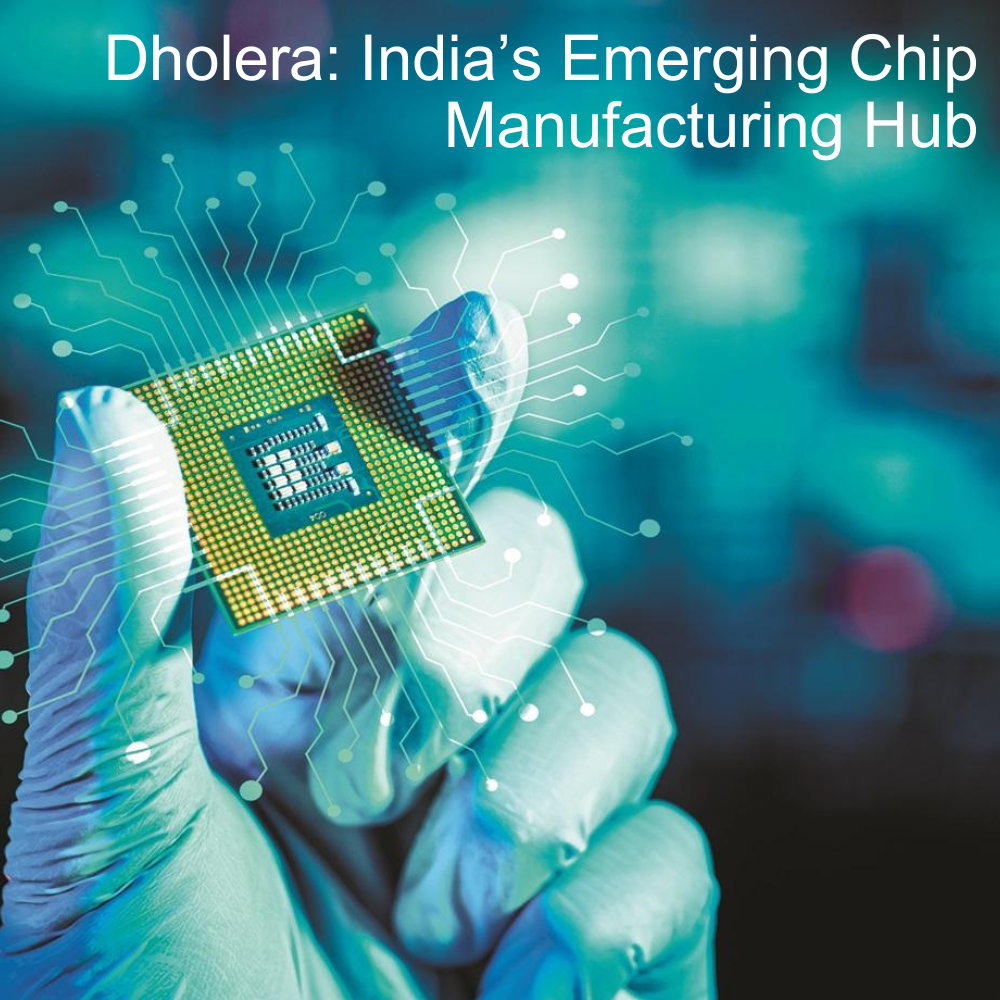
India’s long-standing ambition to become a global semiconductor manufacturing hub has received a major boost with Tata Group’s landmark partnership with Intel. The massive investment, estimated at around ₹1.18 lakh crore, marks a decisive step toward building a robust chip manufacturing ecosystem in the country. With Dholera in Gujarat emerging as the focal point of this transformation, the deal is being seen as a turning point for India’s technology, manufacturing, and economic future.
Semiconductors are the backbone of modern technology. From smartphones and electric vehicles to artificial intelligence, defense systems, and medical devices, chips power almost every aspect of the digital world. Despite being one of the largest consumers of electronics, India has traditionally depended heavily on imports for semiconductors. The Tata–Intel collaboration directly addresses this strategic gap.
The agreement aligns closely with the Government of India’s Semiconductor Mission, which aims to make the country self-reliant in chip manufacturing and reduce dependency on global supply chains that have proven vulnerable in recent years. By partnering with Intel, one of the world’s most experienced semiconductor giants, Tata Group brings global expertise together with India’s industrial strength.
Dholera Special Investment Region (SIR) in Gujarat has been identified as the site for this ambitious semiconductor project. Strategically located with excellent connectivity, modern infrastructure, and strong policy support from both the central and state governments, Dholera is fast becoming India’s answer to global semiconductor hubs like Taiwan and South Korea.
The choice of Dholera is not accidental. Gujarat has consistently positioned itself as a manufacturing-friendly state, offering ease of doing business, reliable power and water supply, and investor-friendly policies. The semiconductor plant planned here is expected to be one of the most advanced facilities in the country, focusing on chip fabrication and advanced packaging.
The proposed investment of ₹1.18 lakh crore is among the largest single investments in India’s technology manufacturing sector. Such a massive capital infusion will have a multiplier effect on the economy. Beyond direct investment, the project is expected to attract a wide network of ancillary industries, including suppliers of raw materials, equipment manufacturers, logistics providers, and research institutions.
Economists estimate that semiconductor manufacturing has one of the highest employment multipliers in the industrial sector. Thousands of direct high-skilled jobs will be created in areas such as chip design, fabrication, testing, and quality control. In addition, lakhs of indirect jobs are expected across supporting industries, construction, services, and logistics.
The Tata–Intel partnership strongly reinforces the “Make in India” initiative. Semiconductor manufacturing is not just another industry; it is a strategic capability that determines a nation’s technological independence. By producing chips domestically, India can strengthen its electronics manufacturing sector, which includes smartphones, consumer electronics, automotive electronics, and renewable energy systems.
This development also enhances India’s attractiveness as a global manufacturing destination. Multinational companies looking to diversify their supply chains away from single-country dependence will see India as a credible alternative. Over time, this could position India as a reliable supplier of semiconductors to global markets.
One of the most significant advantages of the Tata–Intel deal is the potential for technology transfer. Intel’s decades of experience in semiconductor design and manufacturing can help accelerate India’s learning curve in this highly complex industry. Advanced manufacturing processes, quality standards, and research practices introduced through this collaboration will raise the overall capability of India’s technology ecosystem.
Skill development will be another major outcome. Semiconductor manufacturing requires highly trained engineers, technicians, and researchers. To meet this demand, new training programs, partnerships with universities, and specialized institutes are likely to emerge. This will not only support the current project but also build a long-term talent pipeline for India’s semiconductor sector.
In recent years, global semiconductor supply chains have faced disruptions due to geopolitical tensions, trade restrictions, and unexpected crises. Countries around the world are now prioritizing domestic chip manufacturing as a matter of national security and economic resilience. India’s entry into this space comes at a critical time.
By developing its own semiconductor manufacturing capacity, India reduces its vulnerability to external shocks. This is particularly important for sectors like defense, space technology, telecommunications, and critical infrastructure, where secure and reliable access to chips is essential.
Tata Group has a long history of contributing to India’s industrial and technological growth. From steel and power to automobiles and IT services, the group has played a foundational role in shaping modern India. Its entry into semiconductor manufacturing is seen as a continuation of this legacy.
With Tata Electronics leading the initiative, the group is signaling its commitment to building deep-tech manufacturing capabilities within the country. The partnership with Intel adds global credibility and technical strength, making this venture one of the most closely watched industrial projects in India.
The success of semiconductor manufacturing depends heavily on supportive government policies, given the high capital costs and long gestation periods involved. The Indian government has introduced several incentives under its semiconductor policy, including financial support, infrastructure development, and regulatory facilitation.
State-level support from Gujarat further strengthens the project’s prospects. Coordinated efforts between the central government, state authorities, and private industry will be crucial in ensuring timely execution and long-term sustainability.
If executed as planned, the Tata–Intel semiconductor project could mark the beginning of a new era for India’s technology sector. By 2030, India has the potential to be counted among the world’s top semiconductor manufacturing destinations, supplying chips for both domestic use and export.
This development is not just about factories and investments; it represents a strategic shift in India’s economic and technological trajectory. As the world becomes increasingly digital, control over semiconductor manufacturing will define global competitiveness. With this bold step, India is positioning itself to play a significant role in shaping the future of technology.

The Tata–Intel deal is more than a business agreement—it is a statement of intent. It reflects India’s determination to move up the global value chain, from being a consumer of technology to a producer of critical components. With strong industrial leadership, government support, and a clear strategic vision, this partnership has the potential to transform India into a global semiconductor powerhouse and redefine its place in the world economy.
Hemangi believes in the power of words to inspire change and inform readers every day.