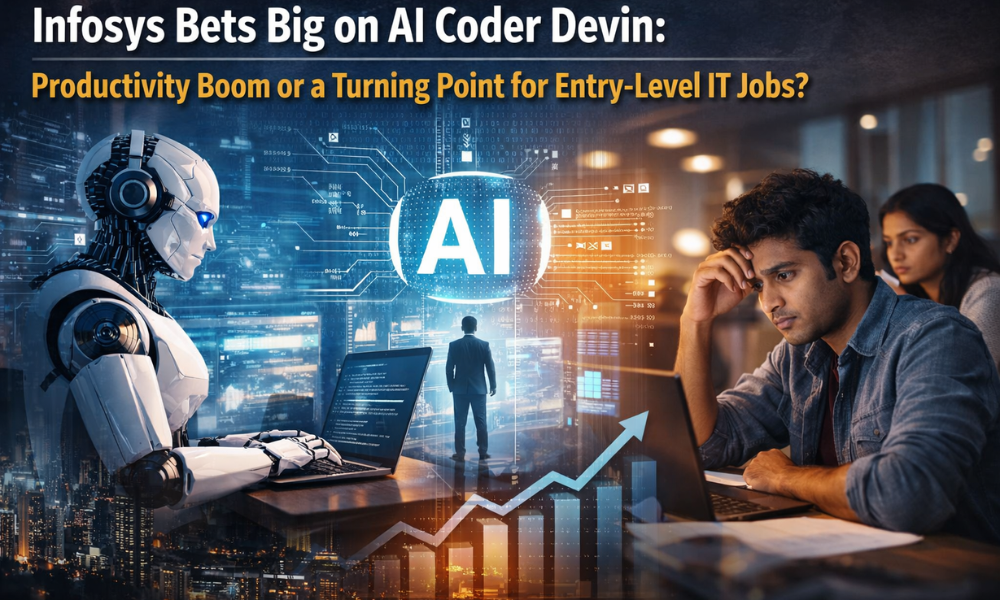
Infosys’s recent decision to implement the autonomous AI coder Devin in its entire setup has brought forth a new wave of debate in the Indian IT sector. Infosys feels that this is a revolutionary step for increasing productivity, whereas young technologists are of the view that this is a threat to “fresher” developer positions. With agentic AI finding its place in software engineering, the service model based on human effort is getting disrupted. The question that arises here is whether AI is accelerating the growth of giant IT companies or transforming the entry-level IT sector in India?
The Infosys–Cognition Partnership: Why Devin Is Central to the Company’s AI Strategy
Infosys’ association with the US-based AI start-up Cognition is all about marking this big push for agentic AI. At the center of this plan is Devin, an autonomous AI software engineer with the ability to handle tasks independently, like writing code, debugging, system migration, and end-to-end engineering workflows, with reduced human intervention. Infosys is looking at Devin as a way to scale delivery capacity while also meeting enterprise clients’ ever-growing demand for faster outcomes with tighter budgets. The company is not marketing AI as some sort of experimentation but integrating Devin directly into its core engineering processes and client projects. This approach fully aligns with Infosys’ broader pursuit of competitiveness in a market driven by automation and efficiency on an unprecedented scale. For Infosys, early and large-scale adoption of Devin is aimed at rewriting the rules of how software services will be delivered in a fast-changing AI-driven technology landscape.
How Devin Is Changing Software Delivery Across Financial Services and Beyond
Devin’s significant application within the banking, payment, insurance, capital markets, and wealth management sectors demonstrates how Infosys is already working with Devin in its Financial Services practice. As a highly advanced AI development tool, Devin automates complex tasks that were manually intensive in nature. As a result of this automation, Devin has decreased development cycles from weeks to days for projects that previously required several hundred workers. Moreover, Infosys intends to utilise Devin in non-financial sectors by expanding its application into other industries, including retail, energy, health, etc. Additionally, what is noteworthy about this development is that Devin is not confined to only Infosys’ use; rather, it will also be integrated into client organisations so that Devin will assist clients in developing their own products or workflows. As part of this collaboration, Devin works in partnership with client development engineers. In doing so, the development and delivery processes will benefit from both the advantages of automation and the value of human engineers’ experience by increasing speed, quality, and effectiveness.
Productivity Gains vs Traditional IT Services Model
The shift away from the traditional IT Services Model toward new ways of doing business and the rise of productivity gains through increasingly capable AI agents and continued evolution of the service model of delivery are compelling.
Large IT Services Companies have always made money by billing for their time and staffing large groups of engineers, based on hours worked and engineers employed. Using Autonomous Agents to perform the work will continue to build on that approach, with higher margins, greater customer satisfaction, and the need for a company’s management team to rethink their workforce planning and pricing structure.
By using Devin, Infosys may be signalling the shift from an hourly/time-based billing model to an outcome-based delivery model and changing the operating model of how large IT Service Companies deliver their services in an AI-driven digital world.
Job Anxiety, Online Backlash, and the Future of Freshers in Indian IT
The announcement of the roll-out of Devin from Infosys has caused a lot of reactions from across social media involving junior engineers and fresh graduates entering the workforce. Many people voiced their concerns that AI-assisted automation may lead to reduced hiring for new entrants into the job market and that junior developers would experience a diminished capacity for learning in time-honoured ways that the junior developer position has traditionally afforded. The tone of these comments was broad and included sarcasm and humour as well as more direct insights into what the future might look like for software engineers and IT services companies. Some users noted that Infosys was choosing to invest in AI technology rather than investing in the salary increases for freshers. Others stated that many of the basic coding tasks previously performed by junior developers will now be performed by AI agents. Not all of the responses to the Infosys announcement were negative. Some sections of the IT community believe that AI will allow large IT companies to increase their ability to compete and will create additional opportunities for workers, including opportunities for oversight, governance, and integration of AI technology into business operations. At this time, uncertainty remains regarding the implications of AI adoption on the employment of freshers in India, creating ongoing anxiety throughout the IT workforce in India.
Conclusion
Infosys’s massive adoption of the AI-powered coder, Devin, is a turning point for the Indian IT services sector. Although the corporation stresses the benefits of faster delivery, optimized costs, and increased productivity, the adoption also lays bare its concern for the future of entry-level engineering jobs. Since the AI tool is now undertaking both mundane and intricate coding chores, the conventional entry-level, service-oriented business for fresh engineers to develop and advance is being rebuilt. Meanwhile, the increased adoption of AI might, in a significant manner, propel the sector towards its next phase of more senior tasks, including monitoring, architecting, and managing AI. This could either lead to a reduced number of employment opportunities or a complete makeover, in terms of the career advancement structure, for tech-related jobs.