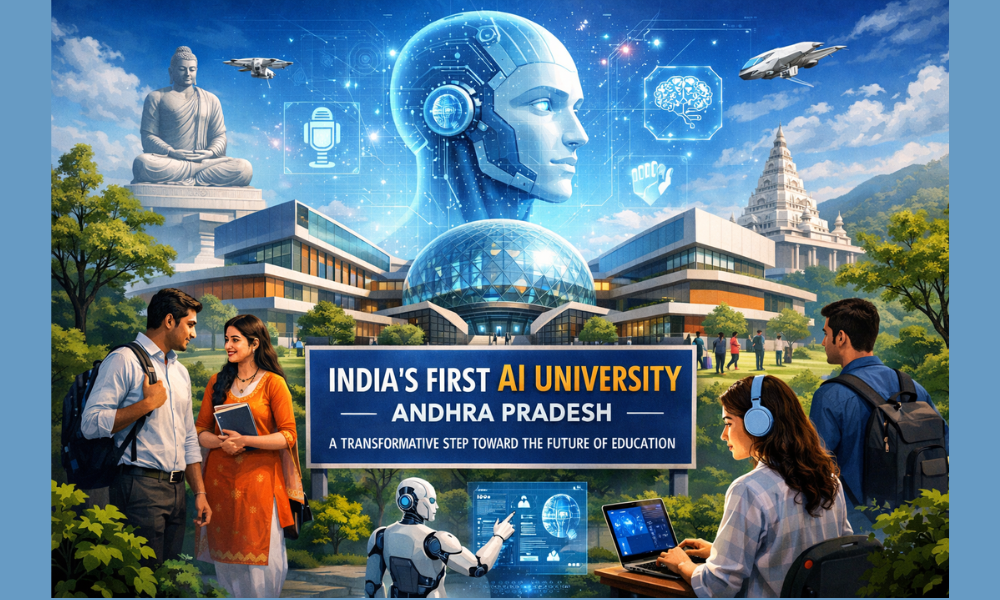
In a landmark move that signals India’s growing commitment to advanced technology and future-ready education, the state of Andhra Pradesh has announced the establishment of the country’s first dedicated Artificial Intelligence (AI) University. The ambitious initiative is set to redefine how students engage with emerging technologies by introducing AI-focused education from as early as the 8th grade. With admissions expected to begin in 2029, this pioneering institution aims to position India as a global leader in AI research, innovation, and skilled workforce development.
A Vision for the Future
Artificial Intelligence is rapidly transforming industries across the globe—from healthcare and agriculture to finance, manufacturing, education, and governance. Recognizing this technological shift, the Andhra Pradesh government has taken proactive steps to integrate AI education into the mainstream academic structure. The AI University is envisioned not merely as a higher education institution but as a comprehensive ecosystem for innovation, research, and practical application.
The university will be developed in Amaravati, the state’s capital region, over a vast area of land equipped with cutting-edge infrastructure. The campus is planned to feature modern laboratories, research centers, incubation hubs for startups, collaborative industry spaces, and digital learning facilities. This futuristic environment is expected to nurture creativity, experimentation, and interdisciplinary research.
Early Introduction to AI Education
One of the most distinctive aspects of this initiative is the decision to introduce AI education at the school level. Students will have the opportunity to begin learning AI-related concepts from Class 8 onward. The curriculum is expected to gradually build foundational skills in coding, computational thinking, data analysis, and machine learning.
By exposing students to AI at an early age, the state aims to develop critical thinking, problem-solving abilities, and digital literacy. Rather than limiting AI education to specialized postgraduate programs, this model integrates technological learning into the broader educational journey. Students will progress from basic AI principles in middle school to advanced theoretical and practical applications at the university level.
This long-term academic pipeline is designed to ensure continuity in learning and to cultivate a generation of innovators who are well-versed in emerging technologies by the time they enter higher education or the workforce.
Comprehensive Academic Structure
The AI University is expected to offer a wide range of undergraduate, postgraduate, and doctoral programs focused on Artificial Intelligence and allied disciplines. These may include:
In addition to core AI subjects, the university is likely to incorporate interdisciplinary programs that merge AI with fields such as healthcare, agriculture, finance, environmental science, and public policy. This approach reflects the growing reality that AI is not confined to computer science but intersects with nearly every sector of society.
The curriculum is expected to emphasize both theoretical foundations and hands-on learning. Students will work on real-world projects, internships, industry collaborations, and research assignments that address contemporary challenges. The focus will be on developing practical skills alongside academic excellence.
Collaboration with Industry and Global Institutions
To ensure global standards and relevance, the university plans to collaborate with leading technology companies, research institutions, and international universities. Such partnerships may facilitate faculty exchange programs, joint research initiatives, and global certification opportunities.
Industry collaboration will play a central role in shaping the curriculum and research agenda. By aligning academic programs with industry demands, the university aims to produce graduates who are job-ready and capable of contributing immediately to the AI ecosystem. Startup incubation centers within the campus may encourage entrepreneurship, allowing students and researchers to transform innovative ideas into commercially viable solutions.
Boosting Research and Innovation
Beyond education, the AI University is intended to serve as a national hub for AI research and innovation. Research centers within the campus will focus on cutting-edge developments in machine learning, automation, and intelligent systems. Special emphasis may be placed on AI solutions tailored to India’s unique socio-economic challenges.
For example, AI-driven tools can improve crop yield predictions for farmers, enhance diagnostic accuracy in rural healthcare settings, optimize urban traffic management, and strengthen disaster response systems. By fostering applied research, the university aims to bridge the gap between theoretical knowledge and practical implementation.
The institution is also expected to encourage interdisciplinary research by bringing together experts from computer science, mathematics, engineering, social sciences, and management. This collaborative environment will support holistic solutions that address ethical, legal, and societal implications of AI.
Economic and Employment Impact
The establishment of India’s first AI University is likely to have significant economic implications. As AI continues to shape global markets, the demand for skilled professionals in this field is rising rapidly. By creating a steady pipeline of trained AI experts, Andhra Pradesh positions itself as a major technology hub within the country.
The project is expected to generate employment opportunities not only for educators and researchers but also for support staff, construction workers, and industry partners. Moreover, the presence of a specialized AI institution may attract tech companies, research labs, and startups to the region, stimulating local economic growth.
In the long run, graduates of the university could contribute to India’s digital economy by developing AI-driven products and services that enhance productivity and competitiveness.
Ethical and Responsible AI Development
As AI systems increasingly influence decision-making processes, ethical considerations become crucial. The proposed AI University is likely to incorporate courses and research initiatives focused on responsible AI development. Topics such as data privacy, algorithmic bias, transparency, and accountability will form an essential part of the academic framework.
By promoting ethical AI practices, the institution can ensure that technological advancement aligns with social values and human rights. This balanced approach will help build trust in AI systems and encourage sustainable innovation.
A National Milestone
The announcement of India’s first AI University marks a significant milestone in the country’s educational and technological journey. It reflects a forward-thinking strategy that recognizes the transformative potential of Artificial Intelligence.

By starting AI education at the school level and extending it through advanced university programs, Andhra Pradesh is creating a comprehensive learning ecosystem that prepares students for the challenges and opportunities of the future. The initiative demonstrates a commitment to innovation, skill development, and global competitiveness.
As the world moves toward an increasingly digital and automated era, the establishment of a dedicated AI University sends a strong message: India is not merely adapting to technological change—it is preparing to lead it. With thoughtful planning, strong industry partnerships, and a focus on ethical development, this ambitious project has the potential to reshape the landscape of higher education and position the nation at the forefront of the AI revolution.
Kinjal is a professional content creator with a passion for turning thoughts and ideas into engaging, impactful words. She enjoys exploring a wide range of topics and brings creativity, clarity, and enthusiasm to everything she writes.