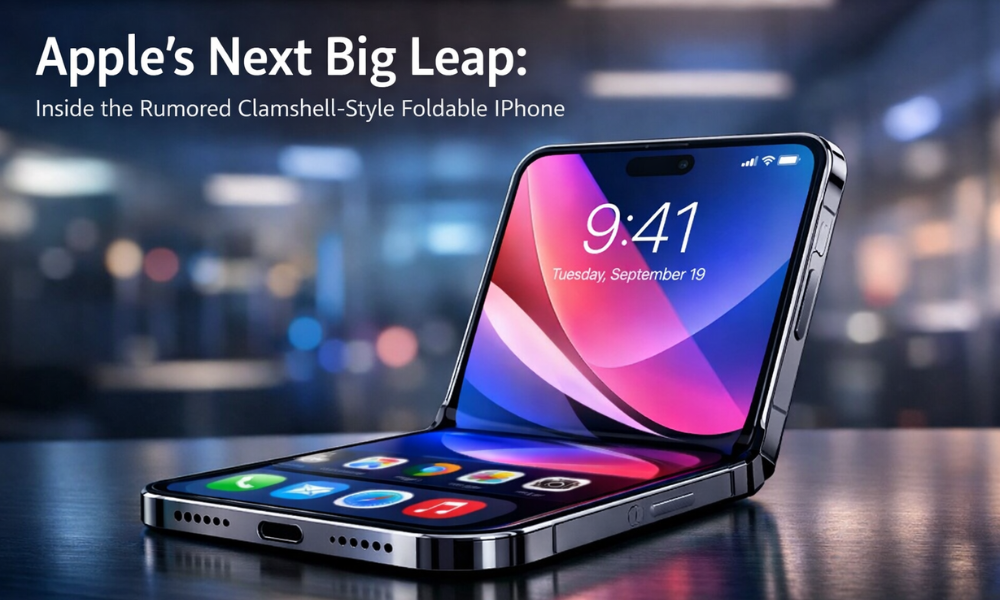
Apple has long been known for entering product categories later than competitors—but redefining them once it does. From smartphones to smartwatches and wireless earbuds, the company’s strategy has been consistent: observe, refine, and then deliver a polished experience. Now, according to multiple industry reports and supply-chain insights, Apple may finally be preparing to take its most anticipated step yet the launch of a clamshell-style foldable iPhone. While Apple has not officially confirmed anything, the growing volume of leaks, patents, and analyst predictions suggests that a foldable iPhone is no longer a question of “if,” but “when.”
Foldable smartphones are no longer experimental concepts. Brands like Samsung, Motorola, Huawei, and Oppo have already established strong positions in this segment. Yet Apple has remained noticeably absent. This silence has fueled speculation for years, but recent reports indicate that Apple is actively testing foldable display technology, particularly a clamshell design similar to the Samsung Galaxy Z Flip or Motorola Razr.
Unlike book-style foldables that open into tablet-sized screens, a clamshell foldable focuses on compactness, portability, and style. This design aligns closely with Apple’s core philosophy of minimalism and everyday usability, making it a logical entry point for the company into the foldable market.
Apple’s decision to reportedly focus on a clamshell-style foldable instead of a larger book-style device appears strategic. A flip-style phone offers several advantages that fit Apple’s ecosystem and customer base. First, it maintains the familiar smartphone experience without radically changing user behavior. Second, it appeals to users who value compact design—something Apple once championed with smaller iPhone models.
From a technical standpoint, a clamshell foldable is also less complex than a tablet-style foldable. It requires fewer compromises in app design, multitasking, and iOS optimization. For a company known for perfectionism, starting with a simpler foldable form factor allows Apple to deliver a refined product rather than an experimental one.
One of the biggest hurdles in foldable devices has been the display crease. Apple is reportedly unwilling to release a foldable iPhone unless it can significantly minimize or eliminate the visible crease that appears on most current foldable screens. Industry insiders suggest that Apple has been working closely with display suppliers to test advanced OLED panels and hinge mechanisms that improve durability and visual consistency.
Apple’s history with display innovation—from Retina displays to ProMotion technology—suggests that the company will not compromise on screen quality. If and when the foldable iPhone launches, it is expected to set new benchmarks for brightness, color accuracy, and longevity.
Foldable phones face durability concerns that traditional smartphones do not. Hinges, folding glass, dust resistance, and long-term reliability are critical factors. Apple’s reputation rests heavily on build quality, which explains why development has reportedly taken longer than expected.
Leaks suggest Apple is experimenting with advanced hinge materials, possibly using liquid metal alloys or reinforced titanium components. These materials could significantly reduce wear and tear over time. Apple is also rumored to be testing foldable screens that can withstand hundreds of thousands of folds without degradation—a standard that aligns with its long-term product reliability goals.
Hardware alone will not define Apple’s foldable iPhone. The real differentiator will be software. A clamshell foldable introduces new usage patterns—partial folding, quick interactions on a smaller external display, and adaptive app layouts. Apple’s strength lies in tightly integrated hardware and software, and iOS is expected to be heavily optimized for this new form factor.
Reports suggest Apple is exploring features like contextual widgets on the outer screen, enhanced continuity between folded and unfolded states, and smarter power management. These refinements could make the foldable iPhone feel less like a novelty and more like a natural evolution of the smartphone.
Apple’s delayed entry into the foldable market is both a risk and an advantage. On one hand, competitors have already established brand recognition and consumer trust in foldable devices. On the other, Apple benefits from years of real-world data, allowing it to avoid early mistakes and focus on what users truly want.
Analysts believe Apple may wait until foldable technology becomes more cost-effective and reliable before launching its device. This approach could help Apple introduce a foldable iPhone at a time when consumer skepticism around durability has diminished, increasing adoption rates.
Foldable phones are expensive, and Apple products traditionally sit at the premium end of the market. A clamshell foldable iPhone is expected to be priced higher than standard iPhone models but possibly lower than book-style foldables. Industry watchers speculate that Apple may position it as a premium lifestyle device, targeting users who value design, innovation, and brand prestige.
Apple’s pricing strategy could also include positioning the foldable iPhone as a limited or specialized model initially, allowing the company to gauge market response before scaling production.
If Apple launches a clamshell-style foldable iPhone, the impact on the global smartphone market could be significant. Apple’s entry often validates product categories and accelerates mainstream adoption. Accessories, app development, and even competing designs could shift rapidly in response.
For consumers, Apple’s foldable iPhone could redefine expectations around compact smartphones, pushing the industry toward more refined, durable, and user-friendly foldable designs.

The rumored clamshell-style foldable iPhone represents more than just a new product—it symbolizes Apple’s cautious yet deliberate approach to innovation. By waiting for technology to mature and focusing on quality, usability, and ecosystem integration, Apple aims to enter the foldable market on its own terms.
While official details remain scarce, the direction is becoming clearer. A compact, stylish, durable foldable iPhone could mark Apple’s next major evolution in smartphone design. If Apple delivers on its usual standards, the foldable iPhone may not just compete with existing devices—it could redefine the category altogether.
Hemangi is a content writer with experience in business writing, strategy, and professional storytelling.