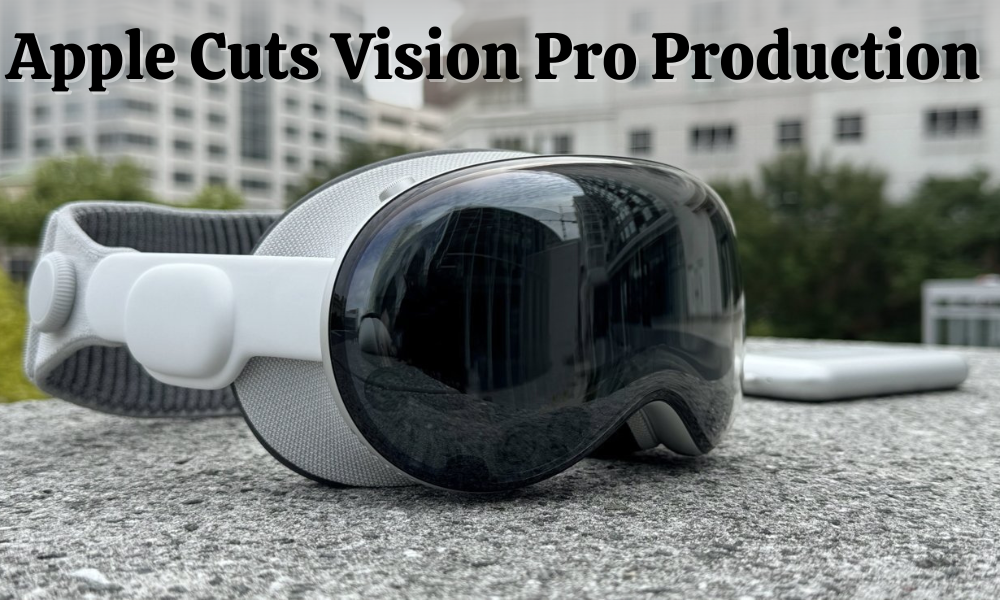
Apple has reportedly reduced production of its ambitious Vision Pro mixed-reality headset, signaling a notable slowdown for one of the company’s most high-profile product launches in recent years. Introduced as Apple’s entry into the world of “spatial computing,” the Vision Pro was positioned as a revolutionary device that could redefine how users interact with digital content. However, recent developments suggest that the headset has struggled to gain traction beyond early adopters, prompting Apple to reassess its production and marketing strategy.
When Apple unveiled the Vision Pro, expectations were sky-high. The headset combined advanced technologies such as ultra-high-resolution displays, eye-tracking, hand-gesture controls, and immersive audio, all powered by a new operating system designed specifically for mixed reality experiences. Apple described the device not as a virtual reality headset, but as a new computing platform that blends digital content seamlessly with the physical world.
With a premium price tag of around $3,500, the Vision Pro was clearly aimed at professionals, developers, and technology enthusiasts rather than mass-market consumers. Apple emphasized productivity, entertainment, and immersive communication as key use cases, showcasing features like virtual workspaces, 3D movies, and lifelike video calls.
Despite the technological sophistication of the Vision Pro, reports indicate that Apple has scaled back its production plans. Manufacturing output has reportedly been reduced significantly, and marketing efforts for the headset have been pared down in several regions. This shift suggests that demand has not met Apple’s initial expectations.
Industry estimates indicate that while early sales were strong among Apple loyalists and developers, momentum slowed considerably over time. By late 2025, quarterly shipments had reportedly dropped sharply, reflecting limited repeat demand and slower adoption among mainstream consumers.
Several factors appear to have contributed to the Vision Pro’s underwhelming performance.
The most obvious challenge has been cost. At a price point far above competing mixed-reality and virtual reality headsets, the Vision Pro remained out of reach for most consumers. While Apple justified the cost by highlighting its advanced components and build quality, many buyers questioned whether the real-world benefits matched the price.
User feedback also pointed to issues related to comfort and everyday usability. Some users found the headset heavy for extended use, while others noted limitations related to battery life and portability. These factors made it difficult to position the Vision Pro as a device for daily, long-term use.
Although Apple launched the Vision Pro with thousands of compatible apps, the ecosystem remains small compared to the vast libraries available for iPhones and iPads. Without a wide range of compelling, must-have applications designed specifically for spatial computing, many potential buyers saw little reason to invest in the platform.
The Vision Pro has been available in only a limited number of countries, further restricting its global impact. This cautious rollout contrasts with Apple’s usual approach to flagship products and may have slowed broader adoption.

Apple’s challenges with the Vision Pro reflect a wider trend affecting the mixed-reality and virtual reality industry. Global headset shipments have declined in recent years as consumer interest has cooled. Many companies that once aggressively promoted immersive technologies are now shifting focus toward artificial intelligence, software services, and lighter wearable devices.
In this context, Apple’s decision to scale back production may be less about failure and more about timing. The market for high-end mixed-reality hardware may simply not be ready for widespread adoption.
While some observers have labeled the Vision Pro a disappointment, others argue that Apple never intended it to be a mass-market product in its first generation. Instead, the headset may have been designed as a foundation — a way to introduce developers to spatial computing and begin building an ecosystem for future devices.
Apple has a long history of entering new product categories cautiously, refining its approach over time. The original Apple Watch, for example, evolved significantly after its initial launch before becoming a mainstream success.
Reports suggest that Apple may now be exploring alternative paths forward, including the development of a more affordable mixed-reality headset or lighter augmented-reality wearables. Such devices could bring spatial computing concepts to a much broader audience.
From a financial perspective, the Vision Pro represents only a small fraction of Apple’s overall revenue. The company continues to rely heavily on iPhones, Macs, iPads, and its growing services business. As a result, the production cut is unlikely to have a major impact on Apple’s short-term financial health.
However, the experience has important implications for Apple’s long-term innovation strategy. The technologies developed for the Vision Pro — including advanced sensors, displays, and user-interaction systems — could influence future products across Apple’s ecosystem.
Looking forward, industry watchers expect Apple to continue investing in spatial computing, but in a more measured way. Possible next steps include:
Rather than abandoning the category, Apple appears to be recalibrating its approach based on real-world feedback.
Apple’s reported decision to cut Vision Pro production highlights the challenges of introducing ground breaking technology to a market that may not yet be ready. While the headset showcased Apple’s engineering prowess and vision for the future of computing, high costs, limited use cases, and broader industry headwinds constrained its appeal.
Whether the Vision Pro is remembered as a misstep or as an important first step will depend on what Apple does next. If the company can translate its lessons into more accessible and practical devices, the Vision Pro may ultimately be seen not as a failure, but as the beginning of Apple’s journey into the next generation of computing.
Hemangi writes content that educates, informs, and inspires a wide audience.