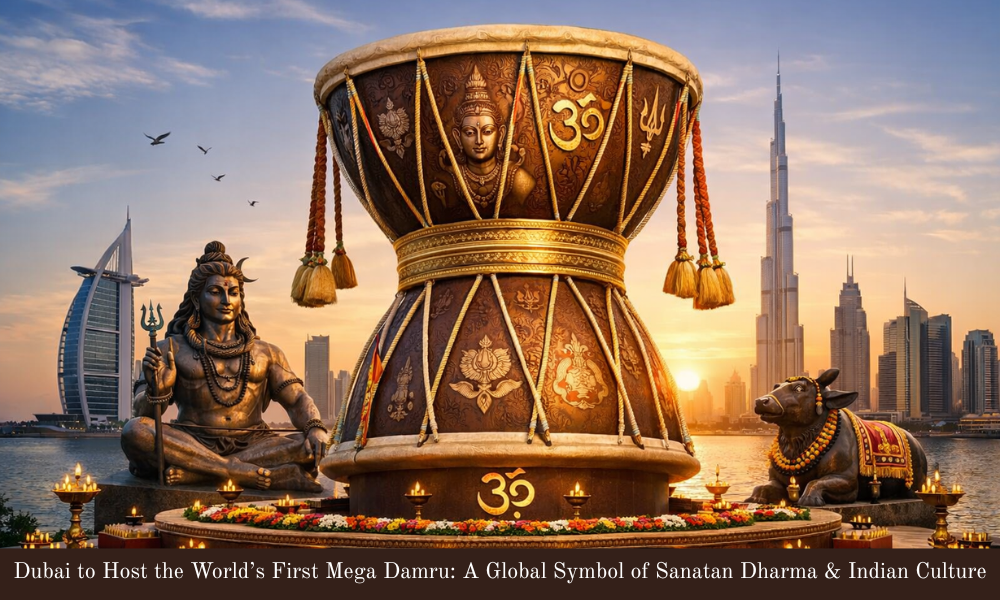
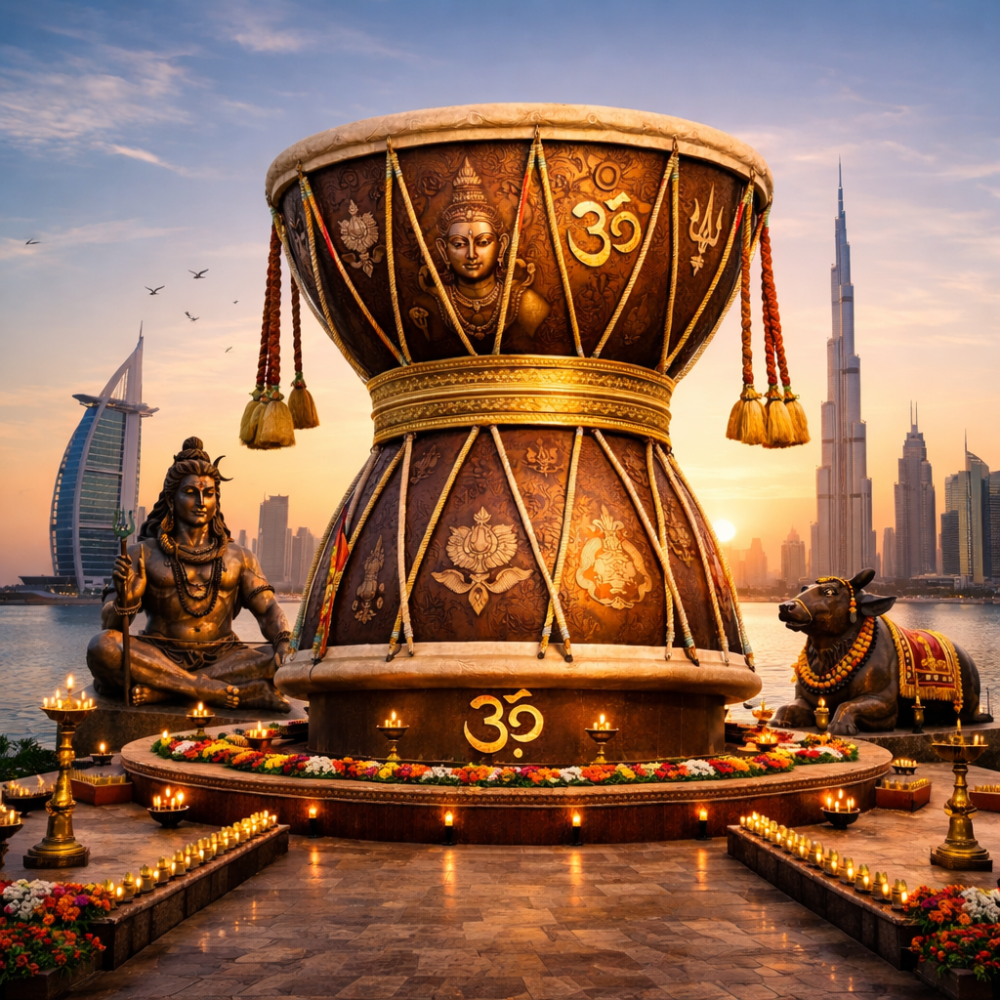
In an era where cities compete to showcase innovation, architecture, and cultural diversity, a powerful new idea is capturing global attention. Dubai, already known for redefining skylines and hosting iconic landmarks, is now set to become the stage for a deeply spiritual and cultural symbol—the world’s first Mega Damru. More than a monumental structure, this project represents the timeless philosophy of Sanatan Dharma and the enduring richness of Indian culture, presented on a global platform.
This initiative is not merely about scale or spectacle. It is about meaning, symbolism, and the dialogue between ancient wisdom and modern civilization.
The Damru holds a special place in Indian spiritual thought. Traditionally associated with Lord Shiva, the Damru symbolizes the rhythm of creation, preservation, and transformation. Its sound is believed to represent the cosmic vibration the pulse of the universe itself.
In Sanatan Dharma, the Damru is not just a musical instrument; it is a metaphor for balance. Its two sides signify duality life and death, silence and sound, chaos and order held together by a central axis of harmony. Transforming this sacred symbol into a Mega Damru elevates it from a spiritual concept into a living, visible expression of philosophy and faith.
Dubai has long positioned itself as a meeting point of cultures, ideas, and global communities. Home to people from hundreds of nationalities, the city thrives on inclusivity and bold vision. Hosting the world’s first Mega Damru aligns naturally with this identity.
By choosing Dubai, the creators of the Mega Damru are sending a clear message: Indian culture and Sanatan Dharma are not limited by geography. Their values—harmony, balance, and universal consciousness belong to the world.
Dubai’s global visibility ensures that the symbolism of the Damru reaches far beyond regional boundaries, introducing millions to the spiritual depth behind Indian traditions.
Modern architecture often focuses on height, scale, and innovation. The Mega Damru project adds another dimension spiritual storytelling through design. Every curve, proportion, and visual element is expected to reflect the philosophical meaning of the Damru.
Rather than being a static monument, the structure is envisioned as an immersive experience. Light, space, and form come together to evoke contemplation and awe. Visitors may not need prior knowledge of Sanatan Dharma to feel its presence; the architecture itself becomes the medium of understanding.
In this sense, the Mega Damru stands at the intersection of art, spirituality, and modern engineering.
Sanatan Dharma is often described as a way of life rather than a religion. Its principles emphasize coexistence, respect for nature, inner balance, and the cyclical nature of existence. The Mega Damru project translates these abstract ideas into a tangible global symbol.
In a world marked by rapid change and constant uncertainty, such symbols offer grounding. They remind humanity of deeper rhythms that transcend borders and belief systems. By placing the Mega Damru on an international stage, these timeless ideas gain renewed relevance.
The monument becomes a quiet yet powerful voice advocating harmony in a fragmented world.
Indian culture has always traveled through trade, philosophy, art, and migration. From yoga and meditation to music and festivals, its influence is already global. The Mega Damru represents the next chapter of this journey.
Instead of being experienced only through texts or rituals, Indian culture here takes architectural form. It invites curiosity, dialogue, and reflection from people of all backgrounds. Tourists, residents, and spiritual seekers alike encounter not just a structure, but a story spanning thousands of years.
This global presentation fosters cultural appreciation rather than mere observation.

Projects like the Mega Damru also reflect a growing cultural confidence. They show that ancient traditions can stand proudly in modern contexts without losing their essence. Sanatan Dharma, rooted in antiquity, proves its timelessness by finding expression in a futuristic city.
This balance between tradition and modernity sends an important message, especially to younger generations that cultural roots and global identity do not contradict each other. Instead, they can coexist and enrich one another.
The Mega Damru thus becomes a bridge between generations as much as between cultures.
Beyond symbolism, the Mega Damru is expected to become a major attraction. Modern travelers increasingly seek experiences that offer meaning, not just entertainment. Spiritual tourism, cultural exploration, and experiential architecture are growing global trends.
The Mega Damru fits naturally into this shift. Visitors are not just viewing a landmark; they are engaging with an idea. The structure encourages pause, reflection, and curiosity—qualities often missing in fast-paced urban tourism.
As a result, the Mega Damru has the potential to redefine how spiritual heritage is experienced in global cities.
One of the most powerful aspects of the Mega Damru project is its ability to spark dialogue. It opens conversations about philosophy, spirituality, and cultural identity in spaces often dominated by commerce and technology.
By standing in Dubai, the Mega Damru invites people from different belief systems to reflect on shared human questions: Where do we come from? What governs the rhythm of life? How do we find balance in a changing world?
Such dialogue is subtle yet transformative.
With great symbolism comes great responsibility. Representing a sacred concept on a global stage requires sensitivity, authenticity, and respect. The success of the Mega Damru will depend on how faithfully it conveys the spirit of Sanatan Dharma, not just its visual appeal.
When done thoughtfully, such projects elevate cultural understanding. When done carelessly, they risk reducing deep philosophies to surface-level imagery. The anticipation surrounding the Mega Damru reflects hope that it will honor its spiritual roots while embracing modern expression.
The world’s first Mega Damru is not just about today’s audience. It is a message for the future. Long after trends change and skylines evolve, the Damru’s symbolism remains relevant reminding humanity of balance, rhythm, and interconnectedness.
As Dubai prepares to host this unprecedented structure, the project stands as a testament to the enduring power of culture and spirituality in shaping global narratives.
The Mega Damru in Dubai represents more than an architectural milestone. It is a global symbol of Sanatan Dharma, Indian culture, and universal harmony. By blending ancient philosophy with modern vision, it speaks to a world searching for meaning amid progress.
In its silent presence and symbolic rhythm, the Mega Damru invites humanity to listen—not just to sound, but to the deeper pulse of existence itself.
Hemangi writes with a purpose — to inform, inspire, and make ideas accessible to all.