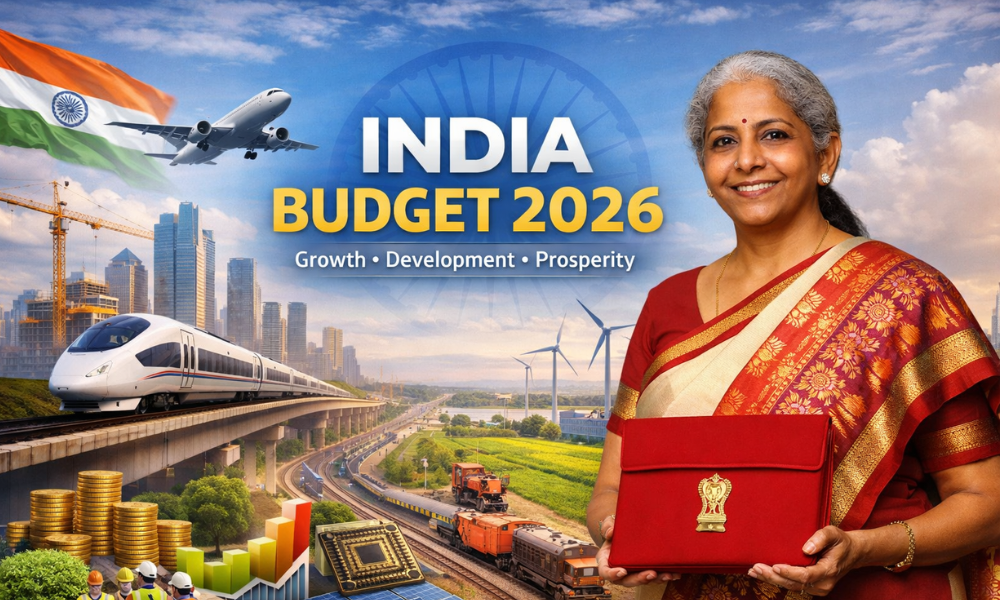
On 1 February 2026, India’s Finance Minister Nirmala Sitharaman presented the Union Budget for the financial year 2026–27 in Parliament. This budget often referred to as Budget 2026 – outlines the government’s revenue and expenditure plans, policy reforms, taxation measures, and growth priorities for the coming year. It reflects the government’s strategic focus on sustainable infrastructure development, strengthening manufacturing, supporting MSMEs, easing tax compliance, and improving quality of life for citizens.
This budget is significant not only for its fiscal allocations but also because it builds on past policy frameworks and charts a long-term vision around infrastructure-led growth, technology and manufacturing self-reliance, and inclusive development.
Fiscal Overview and Economic Priorities
Fiscal Discipline and Growth Targets
The 2026 budget continues India’s commitment to fiscal prudence. The fiscal deficit — the gap between government revenue and expenditure — was targeted at around 4.3% of GDP for 2026–27. Controlling the deficit demonstrates prudent macroeconomic management while ensuring room for growth-oriented spending.
Real GDP growth was projected above global averages, with estimates of over 7% for 2025–26. By combining modest taxation with proactive incentives, the budget attempts to balance growth stimulation with long-term sustainability.
Capital Expenditure: A Record Focus
One of the budget’s standout features is its record high capital expenditure (capex). Government capex was increased to ₹12.2 lakh crore, making infrastructure investment a core pillar of economic strategy. These funds are earmarked for highways, urban development, waterways, railways, freight corridors, and green mobility initiatives.
By raising public capex, the government aims to create jobs, improve connectivity, and enhance long-term growth potential. This emphasis on capex also supports ancillary industries such as construction, steel, cement, and logistics.
Key Sectoral Initiatives
Infrastructure & Connectivity
Budget 2026 reinforced the government’s infrastructure push with several flagship projects:
Seven High-Speed Rail Corridors — connecting major metro and tier-2 cities such as Mumbai-Pune, Pune-Hyderabad, Hyderabad-Bangalore, Delhi-Varanasi, and more. These corridors aim to revolutionize passenger travel, cut transit times, and stimulate regional economies.
Dedicated Freight Corridors — including a new route from Dankuni to Surat, designed to decongest transport bottlenecks and improve goods movement efficiency.
20 New National Waterways — to be operationalised over the next five years, boosting inland water transport and enhancing connectivity for goods and tourism.
Technology, Manufacturing & Innovation
The 2026 budget massively strengthens India’s technology and manufacturing ambitions, focusing on building self-reliance:
Semiconductor Mission 2.0 — an enhanced initiative with a substantial outlay to boost domestic semiconductor fabrication, IP development, and supply chain capabilities.
Electronics Components Manufacturing — outlay increased to ₹40,000 crore to encourage domestic production.
BioPharma Shakti Programme — a ₹10,000 crore investment to make India a global biopharma hub for biosimilars, biologics, and vaccines.
These measures target global competitiveness in high-technology sectors, reduce import dependencies, and foster innovation-led job creation.
Micro, Small & Medium Enterprises (MSMEs)
Recognising MSMEs as vital engines of employment and regional growth, the government announced:
A dedicated ₹10,000 crore SME Growth Fund to support small business expansion and digitisation.
Additional allocation to the Self-Reliant India Fund to empower micro enterprises.
These initiatives aim to make MSMEs more competitive and resilient globally.
Agriculture, Rural & Traditional Sectors

The budget provides strategic support to primary sectors:
Coconut, cashew, and cocoa promotion schemes to increase productivity, ensure market linkages, and support exports.
Expansion of agriculture technology tools and digital services to enhance farmer incomes and connect them with modern markets.
Continued investment in animal husbandry, fisheries, and rural livelihood programmes.
These measures aim to strengthen rural economies and reduce structural disparities.
Healthcare, Education & Social Infrastructure
Budget 2026 significantly boosts social infrastructure, especially healthcare:
Basic customs duty exemptions on 17 cancer drugs and rare disease medicines, making treatments more affordable.
Plans to establish regional medical hubs, integrating Ayush facilities, diagnostics, and post-care services across states.
Enhanced funding to expand emergency and trauma care, mental health institutions, and medical workforce training.
In education, emphasis was placed on skill development, digital learning tools, and capacity expansion, especially in underserved regions.
Taxation & Compliance Reforms
Individual Taxpayers
While income tax slabs remained broadly unchanged, the new budget simplified tax compliance and reduced procedural hurdles for many taxpayers. This includes rationalisation of penalties, decriminalisation of select provisions, and easier filing processes.
Corporate & Global Players
Minimum Alternate Tax (MAT) was reduced to 14% under the new regime, making it a final tax for certain companies — a move aimed at boosting corporate investment sentiment.
Tax holiday until 2047 was introduced for foreign companies providing cloud services through Indian data centres, positioning India as a preferred digital services hub.
These reforms are expected to attract global investors, strengthen India’s digital economy, and simplify the overall tax ecosystem.
Impact on Citizens & Daily Life
For the common man, Budget 2026 delivers both direct and indirect benefits:
Affordable healthcare through duty exemptions on critical medicines.
Improved connectivity via high-speed rail and freight networks.
Job creation from infrastructure, manufacturing, and tech sector initiatives.
Simplified tax compliance reducing burden and disputes for individual taxpayers.
These changes aim to uplift quality of life while driving long-term economic resilience.
A Budget for Growth, Inclusion & Future Readiness
India Budget 2026 marks a strategic blending of growth acceleration, fiscal prudence, and socio-economic inclusion. By prioritising infrastructure, technology, MSMEs, healthcare, and ease of doing business, the government has set a course that seeks not just short-term gains but sustainable, inclusive prosperity.
While challenges remain — such as global economic volatility and implementation pace — this budget has laid a foundational blueprint for the next phase of India’s economic journey.
Kinjal is a professional content creator with a passion for turning thoughts and ideas into engaging, impactful words. She enjoys exploring a wide range of topics and brings creativity, clarity, and enthusiasm to everything she writes.