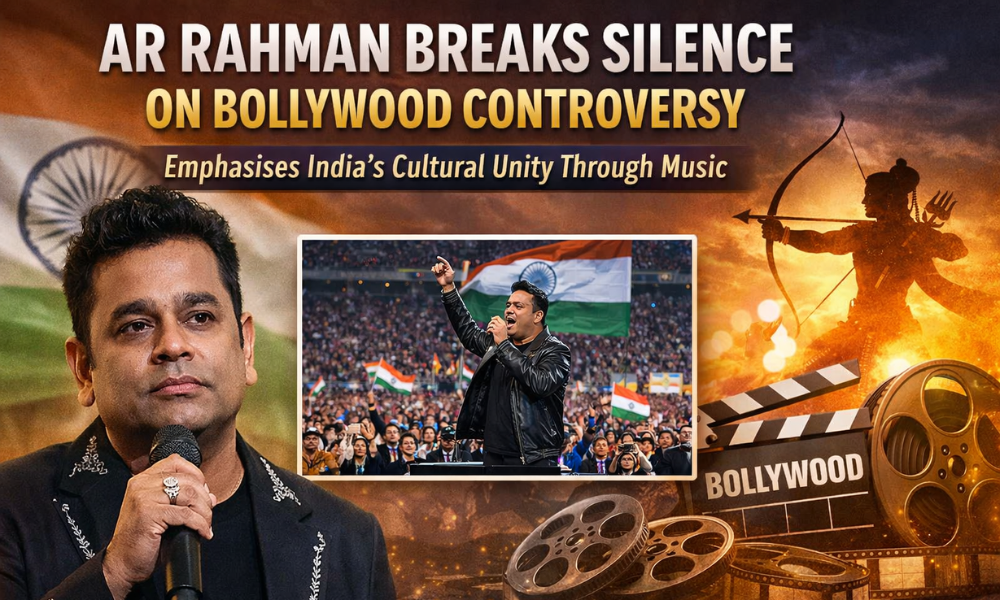
AR Rahman recently made headlines amidst a controversy triggered by statements he made during an interview with the BBC, leading to a lot of debate and discussion in social and entertainment circles. As soon as the news spread, the award-winning music director was forced to come up with a clarification regarding his statement, reiterating his appreciation for India and his views regarding music being a common language.
The Statement That Triggered a Controversy
The debate began immediately following the interview with AR Rahman conducted by the BBC Asian Network, where he was asked about the experience of being a Tamil composer in the Bollywood market and what, if any, prejudice he had faced. This led to a response by Rahman, in which he offered the opinion that while it has not been his experience, a power imbalance has occurred in the market over the past eight years, in the sense that “people who are not creative have the power now.” This occurred in a context where, according to Rahman, “it may be a communal issue, but it is not my issue.” While this response appears to have been framed carefully, it has nonetheless been taken to raise a concern about the possibility of communal prejudice in the Bollywood market. Further debate has been sparked by a criticism by Rahman of the movie Chhaava, in which he suggested it profited by division without explanation.
Social Media Responding To Public Backlash
As a result of the interview, Rahman garnering significant attention through various forms of media and social networking sites created immediate response and backlash, both positive and negative. Many users mentioned Rahman’s choice of words in reference to “communal thing” as ambiguous, while others supported his long history of promoting Indian culture and diversity through his work as a composer. The main factor of controversy surrounding Rahman’s comments was the use of the phrase “communal thing.” Critics questioned the meaning and intent of Rahman’s comment, while advocates stated that when Rahman used the term “communal thing,” he was talking about power dynamics in general and not directed toward any one specific group. Additionally, the discourse surrounding the issue has gone beyond Rahman’s interview into an exploration of creative expression and representation in the Bollywood film industry. This controversy has also caused Rahman to respond publicly to clarify his comments.
Clarification By AR Rahman – On Music, Nations And Intentions
Due to the criticism and backlash that came from Rahman’s statement and comments regarding his comments about the country of India, AR Rahman released a video that outlined his feelings toward the country of India, his connection to the country and his explanation of his viral video post. Rahman reiterated in his video that Music is the way in which he connects with the world and celebrates life. He identifies India as the source of his creative inspiration, the source of his education, and home. Rahman admitted that sometimes the intent (or intent to do something) of an action may be misunderstood, however, his goal has always been to uplift and elevate people through music and never to hurt people. In the video Rahman highlighted many of his contributions to Indian culture through visual images of his iconic piece of music Maa Tujhe Salaam/Vande Mataram being performed at a cricket match, and ranked as the number one most played song in India, by AIR. Rahman also highlighted some of the many projects that display India’s diversity and richness including but not limited to: developing Jhalaa at the WAVES summit, being part of Rooh-e-Noor, working with young Naga musicians, directing orchestras, co-founding the multicultural virtual band Secret Mountain, and scoring Ramayana with Hans Zimmer.
Beyond the Row: How this Debate Represents Bollywood Today
Rahman’s words and the resulting conversation around them have highlighted the larger questions of the nature of the power dynamics of the Indian music and film industries today. The remarks Rahman made about the changing power structure in Bollywood, as well as how he sees his work as a connector of traditional practices to modern creativity, are echoed by the amount of attention that is currently being given to those who control creative content, and how the lack of control represents the ability to censor those creators’ ideas. Simultaneously, Rahman’s comments are indicative of the highly sensitive nature of cultural and communal narratives in discussions that occur publicly. Rahman reiterated his commitment to promoting freedom of expression and to promoting multicultural expression in all forms through his music and his work. He sees himself and his work as a bridge between the past of India and the current and future of India based on cultural respect, inclusivity and nurturing of all artists’ talents. Thus, although the controversy that began with Rahman’s remarks has begun to grow into a more complex conversation about representation, unity and the role of art as a vehicle through which the pluralistic identity of India will continue to be presented and reflected, it has expanded in the form of a larger conversation about social issues that affect all of society.
Conclusion
The clarification by AR Rahman brings the attention back to his longstanding connection with India and his belief in music being able to tie up everyone together. Though his comments created controversy, his response underlined intent over interpretation and contribution over conflict. The episode also brings out deeper discussions around creativity and power in Bollywood. Finally, Rahman clarified that he was committed to celebrating India’s cultural pluralism through music.