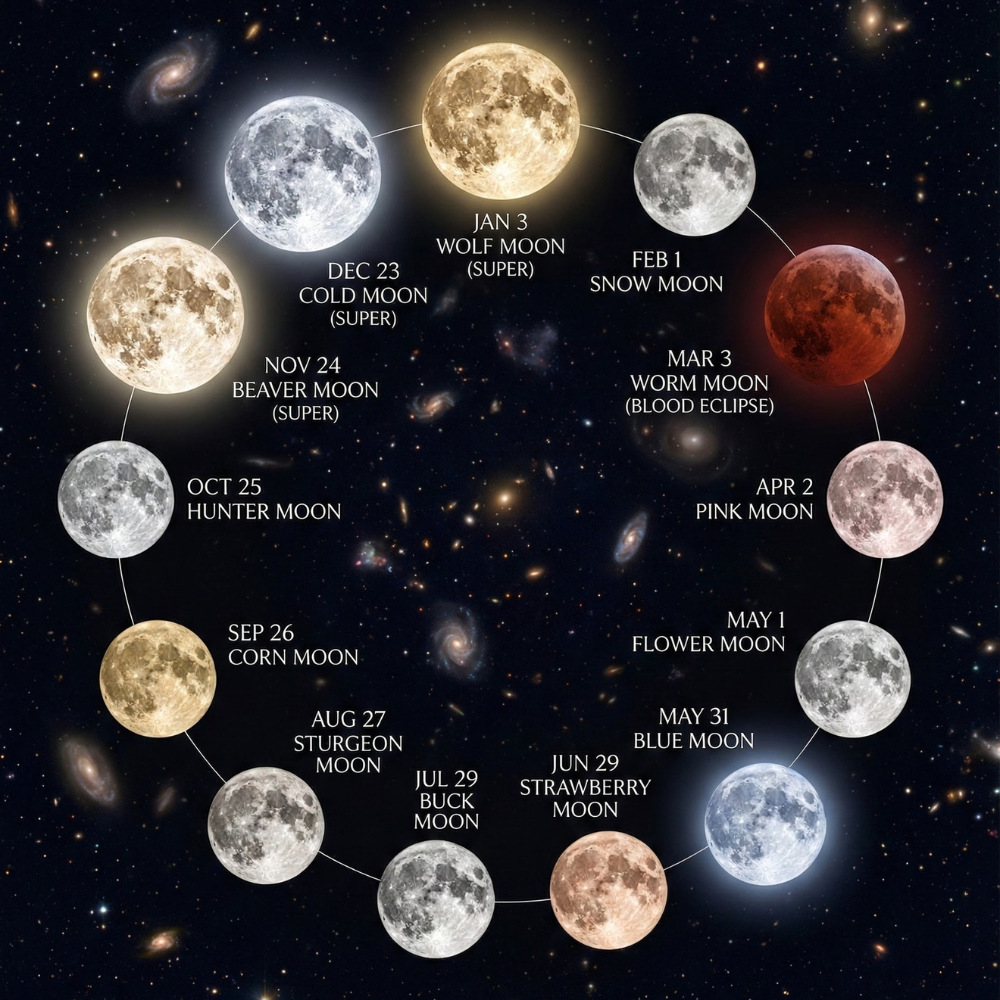
The night sky has always fascinated humanity, serving as a natural calendar, a source of myths, and a guide for farmers, sailors, and storytellers. Among all celestial events, the full moon holds a special place because of its brightness and symbolic meaning. While most years have twelve full moons one for each month some years stand out by offering an extra lunar spectacle. The year 2026 is one such year, set to feature 13 full moons, including the much-talked-about Blue Moon. This rare alignment of lunar cycles makes 2026 an exciting year for astronomers, sky watchers, and anyone who loves gazing at the moonlit sky.
To understand why 2026 will have 13 full moons, it is important to know how the lunar cycle works. A full moon occurs when the Moon is positioned opposite the Sun, with Earth in between, allowing the Moon’s face to be fully illuminated. This cycle from one full moon to the next takes about 29.5 days, known as a synodic month.
Since a calendar year has 365 days, twelve lunar cycles account for only about 354 days. The remaining days accumulate over time, and eventually, this difference results in an extra full moon appearing within a calendar year. When this happens, the year ends up with 13 full moons instead of the usual 12.
In 2026, the timing of the lunar cycles aligns in such a way that the first full moon occurs early in January, and the last one falls near the end of December. Because the gap between full moons is shorter than the length of a month, an additional full moon fits neatly into the year. As a result, one month will experience two full moons, giving rise to what is popularly known as a Blue Moon.
Contrary to its name, a Blue Moon does not usually appear blue in colour. The term is more about timing than appearance. Over time, “once in a blue moon” has become a phrase meaning something rare, and astronomically, a Blue Moon refers to an extra full moon within a specific time frame.
There are two commonly accepted definitions of a Blue Moon. The most widely used modern definition describes it as the second full moon occurring within the same calendar month. Since most months are longer than the 29.5-day lunar cycle, it is occasionally possible for two full moons to occur in one month.
The older, traditional definition refers to a Blue Moon as the third full moon in a season that has four full moons instead of the usual three. Seasons are divided by equinoxes and solstices, and when an extra full moon falls within a season, the third one is labelled the Blue Moon. While both definitions are still used, the monthly definition is more familiar to the general public today.
In 2026, the Blue Moon will occur due to the monthly definition, making it a rare and special sight for sky watchers.
Throughout history, full moons have been given names based on seasons, agricultural cycles, and cultural traditions. Many of these names originated with Native American tribes, early European settlers, and farming communities who relied on the moon to track time and seasonal changes.
When an extra full moon appeared, it sometimes disrupted traditional naming systems. Farmers, for example, depended on full moon names like the Harvest Moon or Hunter’s Moon to plan their work. An extra moon could cause confusion, which is why special terms like “Blue Moon” emerged to mark these anomalies.
In folklore, extra full moons were often seen as omens or signs of change. Some cultures believed they brought heightened emotions, unusual events, or spiritual significance. While modern science explains the phenomenon clearly, the sense of mystery and wonder surrounding a Blue Moon still remains.

From a scientific perspective, a year with 13 full moons is a reminder of the delicate balance between lunar cycles and the solar calendar. It highlights how human-made calendars attempt to organize time based on the Sun, while the Moon follows its own rhythm.
Astronomers and astrophotography’s often look forward to such years because extra full moons provide more opportunities for observation, photography, and public engagement. Each full moon can be studied for surface features, brightness variations, and its interaction with Earth’s atmosphere.
Additionally, full moons play a role in natural phenomena such as tides. When the Moon is full, its gravitational pull combines with that of the Sun, leading to stronger high and low tides, known as spring tides. An extra full moon year like 2026 means more instances of these powerful tidal effects.
In many parts of the world, especially in countries like India, lunar calendars are closely tied to religious festivals and rituals. Full moon days, known as Purnima, are considered auspicious and are often associated with fasting, prayers, and celebrations.
A year with 13 full moons can slightly alter the timing of festivals or add an extra observance to the calendar. While lunar-based calendars are designed to adapt to such changes, the presence of an extra full moon is still noteworthy and sometimes celebrated as a special occurrence.
In Western traditions as well, certain holidays and events linked to lunar phases may be influenced by an extra full moon, adding to the uniqueness of the year.
One common misconception is that a Blue Moon will actually appear blue. In reality, the Moon’s color usually remains the same. However, under rare atmospheric conditions—such as volcanic ash, wildfire smoke, or pollution—the Moon can appear bluish or reddish. This visual effect is unrelated to the astronomical definition of a Blue Moon.
What truly makes the Blue Moon special is its rarity. Most years pass without one, so when it does occur, it becomes an event worth noting and observing, even if it looks like a regular full moon.
The combination of 13 full moons and a Blue Moon makes 2026 a memorable year for anyone interested in astronomy. It offers more chances to observe the Moon at its brightest, learn about lunar cycles, and appreciate how celestial mechanics shape our perception of time.
For beginners, it is a great opportunity to start moon-watching and tracking lunar phases. For seasoned enthusiasts, it provides a chance to reflect on the precision and beauty of cosmic movements that have remained consistent for billions of years.
The year 2026, with its 13 full moons including a rare Blue Moon, serves as a fascinating reminder that our calendar is only an approximation of the natural rhythms of the universe. While the extra full moon may not dramatically change our daily lives, it adds a touch of wonder to the night sky and connects us to centuries of observation, tradition, and curiosity.
Whether viewed through a telescope, captured in a photograph, or simply admired with the naked eye, the full moons of 2026 invite us to slow down, look up, and appreciate the timeless dance between Earth, the Moon, and the Sun.
Hemangi provides professional content solutions for businesses seeking clarity and impact.