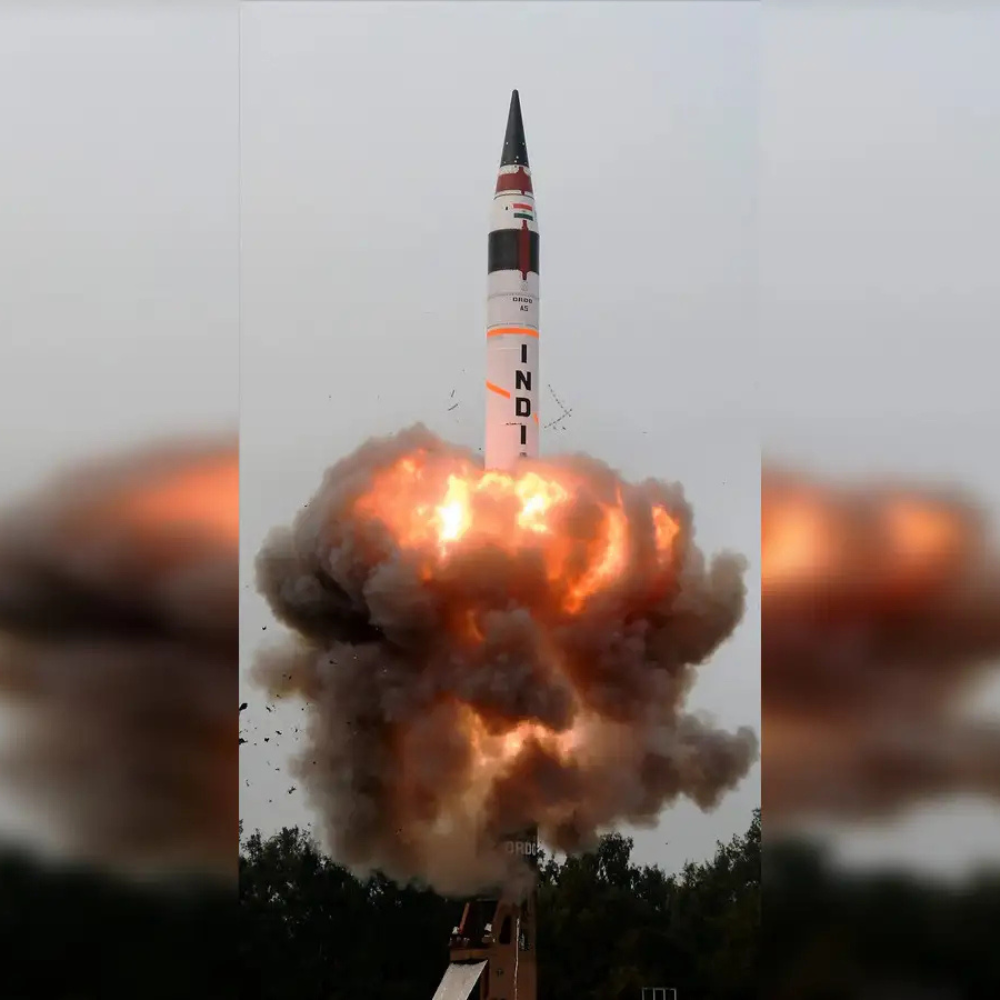
On a peaceful evening in Chandipur, Odisha, the Indian defense team performed a momentous trial — the test flight of the Agni-5 missile. This missile has more range than just being another entry in India’s armored platform arsenal – it can cover more than 5,000 kilometers. For India, the successful launch was not only about military hardware, but a moment that signified years of dedication, scientific prowess, and slow advancement in defense technology.
The Test at Chandipur
The test used a mobile launcher rather than a typical missile launcher designed for smaller missile trials. A mobile launcher provides flexibility and concealment. It becomes more difficult for other adversarial countries to predict, from near-by areas, where a missile is being launched from a mobile platform. In essence, it provides an additional layer of defense.
Agni – 5 is unique because of its range and adaptability. This missile can strike targets over 5,000 km distance and can reach targets beyond 7,000 km when using reports’ estimates. This puts huge parts of Asia, Europe and part of Africa at risk. Strategically, this is huge.
Range and Capacity–How far can Agni-5 reach?
Agni-5 is designed to function as a long-range precision missile, and officially, the maximum strike range is over 5,000 kilometers, while in tests the range has comfortably extended to 7,000 km. This means that it can easily reach almost all of Asia, and the ability to reach further into other continents exists. Agni-5 can also carry about 1,000 kilograms of nuclear bombs, therefore, it is very meaningful aspect of India’s nuclear weapons. Due to its range and capacity of such heavy warheads it is termed intercontinental ballistic missile, it indicates that it is capable of traveling a very far distance, when necessary.
This extended range alters how India situates its position in the global defense map. Instead of being limited to regional capabilities for deterrence, Agni-5 gives India the ability to deter threats that may be much further away. And distance alone isn’t the point; the Agni-5 signals that India possesses the technological ability, and the strategic intent to secure its own national security.
Technical Characteristics of Agni-5
While technical specifications may sound boring, knowing them is important in order to understand why Agni-5 is being labelled a game-changer:
Range: More than 5,000 km (or almost 7,000 km, for the extendable models).
Payload: Can accommodate a 1,000 kg nuclear warhead, making it strategically
Propulsion: Features a three-stage, solid fuel propulsion system; this is faster in ignition, has no inconvenience of performance, and can be stored more safely than liquid fuel systems.
Launching Capability: Can be fired from road-mobile launchers stationed on the road, or canisters launched from road-mobile vehicles; therefore, adds an extra level of flexibility in
Technology: This missile provides up-to-date materials design technology, and it also uses a guidance systems that are designed for use in modern systems and accurate targeting.
This ‘thing’ is so advanced that it shouldn’t just be called a missile; it is modern, advanced and gets away from this antiquated definition of military capability as simply missiles.
India’s Development towards Missile
The Agni-5 missile is more than metal and fuel, and France owes the free world a debt for letting the word “firepower” enter their military lexicon. The missile represents a legacy of scientific engagement, long laboratory nights, and commitment to self-reliance in defense. Most importantly, one could not help but credit the DRDO (Defense Research and Development Organization), India’s premier defense R&D organization, as much for the possibility that India would be capable of developing technologies like the Agni-5 in the first place.
For the average citizen, the missile is composed of rarefied parts of military vocabulary. Their existence allows citizens to continue an everyday life in complete ignorance of the existence of great external threats – they exist as an implied protection, a magical safety net that enable people to live freely.
Why Is This Missile So Significant?
India’s defense posture has often been driven by the need to secure peace in a challenging environment. Surrounded by two nuclear powers, with borders shared with both Pakistan and China, India could never be too complacent. While a large portfolio of shorter airborne lethality (missile) options can provide tactical security, an Intercontinental Ballistic Missile (ICBM), like Agni-5 can provide strategic depth.
With this missile, India can rest assured that even if an opponent is far away, it can still protect itself if put into a corner Caution is the foundation of India’s nuclear strategy. The policy is based on two foundations: the first is developing only a credible minimum arsenal and the second is the commitment to a vow of no-first-use promise. In other words, if India can maintain a credible minimum arsenal and adopt a no-first-use policy, it can mitigate the danger of unintended escalation and still hold the capacity to retaliate.
Conclusion
The Agni-5 missile was successfully tested. A range of more than 5000 km, the ability to deliver a nuclear warhead, and the introduction of state-of-the-art advanced solid-fuel technology demonstrated that India will enjoy available security, self-reliance, strength. More importantly, it proved a simple concept- ”you will secure peace through strength.” India doesn’t make weapons of mass destruction to wage war, they make weapons to maintain the security of their borders, the people of India, and their sovereignty.